
Materials Physics
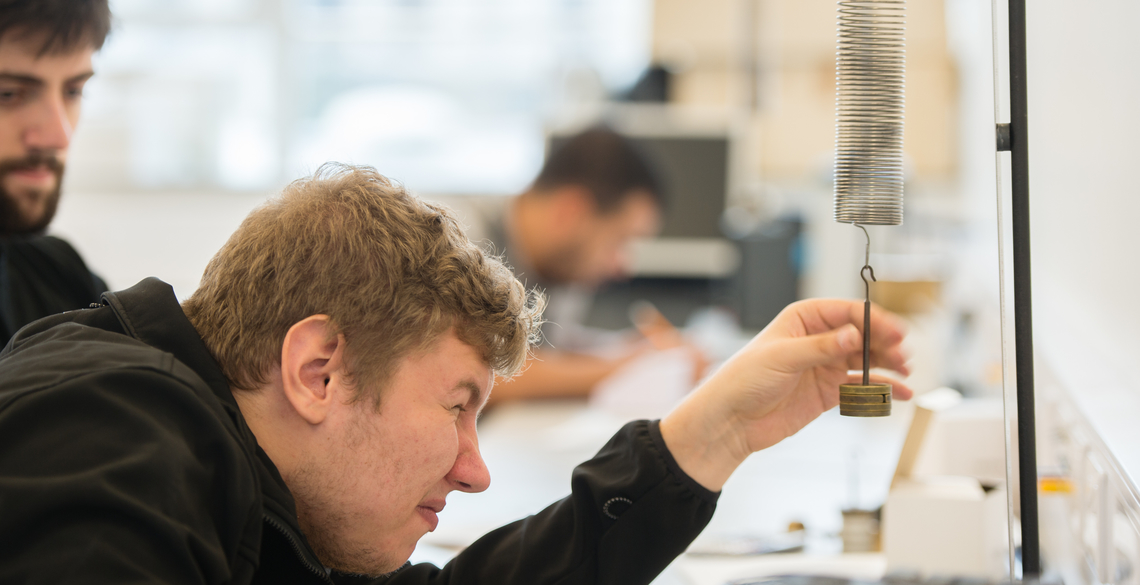
Overview - The materials research group uses a variety of measurement and modelling techniques in order to learn more about industrially relevant materials.
The materials research group uses a variety of measurement and modelling techniques in order to learn more about industrially relevant materials. Materials research at Aberystwyth is centred around several key areas: glasses, zeolites and ceramics, foams and complex fluids, spin physics and control, and semiconductor thin films and surfaces. In each of these areas appropriate techniques are brought to bear, measuring aspects of the materials as they are formed or processed.
Structure of non-crystalline materials
Zeolites and their analogues are of major importance as the substrates for catalysis - their gigantic cavernous microporous structures can be doped with metals like Ni and Co to generate the microscopic centres for catalysis.
Nanocrystalline and high-temperature ceramics
Ceramics are the industrial material of choice when it comes to severe conditions such as high temperatures and steep thermal gradients in melting furnaces, rapid thermal cycling in reactors or chemical corrosion in filter beds.
Integrated Detectors
Building on the 5mm, 192-channel ion detector originally developed at Aberystwyth, the EPSRC-funded REES project has provided a 19mm, 768-channel electron detector that is currently the only one fully-integrated on a single silicon chip that efficiently detects individual electrons with a parallel multi-channel array and also has the necessary robustness.
Structure and Dynamics of Foams
The Foams group in Aberystwyth is interested in modelling the structure and dynamics of foams and related materials. This involves solving partial differential equations, developing numerical simulations and devising related experiments.
Complex Fluids and Flow Processes
The Rheology research group is mainly interested in the flow behaviour of elastico-viscous liquids, namely materials that are predominantly fluid in behaviour but have some of the elastic properties usually associated with solids.
Semiconductor thin films and interfaces
A range of spectroscopic and imaging techniques have been developed to study the electronic and optical properties of semiconductors, in particular organic semiconductors and wide-gap semiconductors such a diamond and boron nitride.
Organic Semiconductors and Supramolecular Materials
Application of molecular semiconductors and conjugated polymers to optoelectronics (photovoltaics/solar-cells, LEDs, transistors). Designing functional materials at the smallest scales; the molecular and supramolecular levels. Investigating fundamental characteristics, such as photophysics, charge and energy migration, chirality and morphology. Feedback into advanced chemical synthesis strategies, via a network of international collaborations.
Spin physics - characterization and control
Nano-magnetic and spin properties of materials have important applications ranging from Nuclear Magnetic Resonance to Quantum Computation. We study theoretical properties of nitrogen-vacancy centres, quantum dots and other artificial spin systems, focussing on characterization of their many-body properties and on control of their dynamics using electromagnetic pulses.
Optical Characterisation
Optical techniques are important in the characterisation of materials in addition to providing important information on the fundamental physics associated with them. A range of optical instrumentation is available in-house of which the most important are Raman spectroscopy and ellipsometry.