
Centre for Health and International Relations (CHAIR)
Welcome
'Welcome to the Centre for Health and International Relations (CHAIR). CHAIR was founded in 2003 in the belief that there are compelling reasons for linking health and international relations. It has now developed as part of a worldwide network of scholars working on the interface between health and IR. Please feel free to contact us to discuss our current research'.
~ Professor Colin McInnes, Director of CHAIR
News Archive
Colin McInnes will be giving a paper entitled 'Institutional structures and non-state actors for global health' to the 2013 Canada-UK Colloquium at Cumberland Lodge, Windsor Great Park, 22-23 November 2013. During an extensive dissemination 'tour' in Australia in late November / early December, Colin will also be giving papers on 'Global health governance: visions and challenges' to a combined University of Queensland-Griffith University Seminar; and on 'Global health governance for the 21st century' to a conference at the University of Sydney.
Kelley Lee will be giving a paper entitled 'The global restructuring of the tobacco industry in Asia: Implications for public health policy' at the international conference: Public Health Policy in Asia: Rights, Risks, Redistribution and Resilience, being held at the University of British Columbia, 6-7 December 2013.
Dr Rob Doble
Warmest congratulations to LSHTM-based PhD student Rob Doble, who successfully defended his PhD viva on 21 October. His thesis is entitled: 'Understanding NGO influence in Global Health Governance: An evaluation of the HIV/AIDS medicines patent pool and advance market commitment for pneumococcal vaccine'. His supervisors were Kelley Lee and Adam Kamradt-Scott, with support from Anne Roemer-Mahler. Thank you to Ted Schrecker (Durham) and Sophie Harman (Queen Margaret) for serving as his examiners.
Dissemination material
There are now two documents detailing project findings available to download: 'Health is Not Enough': Transformations of GHG (PDF) discusses the project findings in detail, whereas Transformations of GHG - Key Findings (PDF) gives a more compact summary.
UNESCO Colloquium
 On 6 June, Colin McInnes participated in a one day Colloquium entitled ‘Supporting UNESCO Effectiveness and Reform: How Can Wales Contribute’. This prestigious event was held under the auspices of the UK National Commission for UNESCO, in association with Aberystwyth University and the Learned Society of Wales and hosted by the Department of International Politics.
The keynote address was given First Minister, Rt. Hon Carwyn Jones. Professor Gretchen Kalonji (Assistant Director General for Natural Sciences at UNESCO) was among a raft of high level speakers and delegates discussing the current and future relationship between Wales and UNESCO.
Special Supplement ('Framing Global Health Governance') of Global Public Health
(Volume 7, Supplement 2, S83-S198)
- Colin McInnes, Adam Kamradt-Scott, Kelley Lee, David Reubi, Anne Roemer-Mahler, Simon Rushton, Owain David Williams and Marie Woodling, 'Framing global health: The governance challenge'
- Adam Kamradt-Scott, 'Evidence-based medicine and the governance of pandemic influenza'
- Adam Kamradt-Scott and Colin McInnes, 'The securitisation of pandemic influenza: framing, security and public policy'
- Owain David Williams, 'Access to medicines, market failure and market intervention: A tale of two regimes'
- Marie Woodling, Owain D. Williams and Simon Rushton, 'New life in old frames: HIV, development and the ‘AIDS plus MDGs’ approach'
- Simon Rushton, 'The global debate over HIV-related travel restrictions: Framing and policy change'
- David Reubi, 'Making a human right to tobacco control: Expert and advocacy networks, framing and the right to health'
- Colin McInnes and Kelley Lee, 'Framing and global health governance: Key findings'
Global Health and International Relations
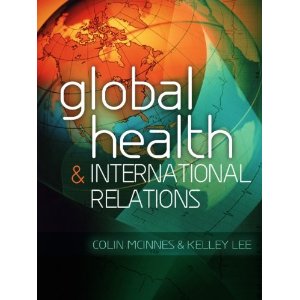
Colin McInnes and Kelley Lee's highly acclaimed new book, Global Health and International Relations, has now been published by Polity and is receiving very favourable reviews. Courtney McNamara has stated that it is 'an essential resource for any student or professional engaged with these issues' (Critical Public Health), and Arthur van Deth (Director of International Programs, Department of Health Care Management, Flinders University, Adelaide) highlights that:
'This book provides a brilliant analysis of the intersection of the fields of IR and Public Health in a global context. It is clearly written, logically coherent and well referenced, illustrated with numerous recent and current examples from the field, reflecting the authors' backgrounds in International Politics and Global Health and Development respectively'
In addition:
'Colin McInnes and Kelley Lee give us an enormously rich exposition of the modern global health enterprise. Global Health and International Relations must be read as it offers the most sophisticated and penetrating analysis of global health governance in the literature. I will have their book on my shelf as a critical reference for my scholarship on, and advocacy for, global health with justice' - Professor Lawrence O. Gostin, Johns Hopkins University
'McInnes and Lee have clearly demonstrated the link between international relations and global health, and in a language understood by btoh target audiences. By doing so, they have brought to life the Oslo Ministerial Declaration of 2007 in which ministers of foreign affairs from seven governments stated that global health is a pressing foreign policy issue' - Professor David L. Heymann, Head and Senior Fellow, Chatham House Centre on Global Health Security
For more details please click here.
'Competing Visions of Global Health Governance' - Chatham House, 11 May 2012
 CHAIR and LSHTM, in collaboration with the Chatham House Centre on Global Health Security and with the support of the BISA Global Health working group, held the first in a series of project dissemination events hosted at Chatham House in London on 11 May 2012.
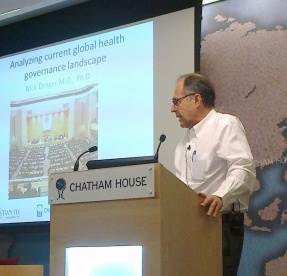 This event presented early findings of the 4-year ERC-funded project, looking particularly at four pressing contemporary global health issues:
- HIV/AIDS
- access to medicines
- tobacco control
- pandemic influenza
Professor Nick Drager kindly agreed to provide an overview of the current global health governance landscape.
A full report of the event is available to download here (PDF). The following policy recommendations were also made:
-
Successful GHG must be grounded in an acceptance that it is an inherently political space, and one which is not limited to technical
solutions based on 'best practice', cost effectiveness or evidence. -
GHG is not based on a single underlying logic. Rather it is characterized by competing frames, each with its own logic, language and preferred policy pathways. This creates a complex and contested policy space where different frames (and the worldviews they represent) vie for dominance. GHG should actively engage with the divergent problem definitions and policy solutions these frames imply.
-
Smart advocacy can be developed where an issue can be strategically framed in different ways to appeal to different audiences within specific contexts and timeframes, in order to achieve desired policy outcomes.
-
Policy can be advanced through counter-framing. This involves challenging the dominant vision of an issue by framing it in new ways. Examples here include the human rights frame being applied to access to medicines and the reframing of hitherto industry-led economic justifications for not strongly regulating tobacco.
-
Framing speaks to sectors outside health (including development, security and macro-economics, for example) and may therefore
be used to develop a multi-sectoral approach to GHG.
Research
Whilst pursuing research on the general global politics of health, CHAIR is currently working on a number of principal research areas:
- The global governance of health, particularly on the role of international organisations in generating what are often inchoate responses to health crises. CHAIR has just embarked on a major, ERC-funded project entitled 'The Transformation of Global Health Governance: Competing World Views and Crises' (see below) in association with Centre on Global Change and Health at the London School of Hygiene and Tropical Medicine (LSHTM)
- The politics and securitization of infectious disease, most notably HIV/AIDS
- The role of the World Health Organisation (WHO) and International Health Regulations (IHRs) in the global governance of health
- The links between health, conflict and peace
- The issue of access to medicines
'Transformation of Global Health Governance: Competing World Views and Crises'
 The European Research Council has awarded Professor Colin McInnes, Director of CHAIR, €2.35 million for a 4-year project (although recently extended for an additional year) on 'The Transformation of Global Health Governance: Competing World Views and Crises'. The project began in January 2009 and will conclude in December 2013.
Professor McInnes is working alongside the Co-investigator Professor Kelley Lee of the London School of Hygiene and Tropical Medicine. The project also involves the following research fellows: Dr. Simon Rushton (previously CHAIR, now University of Sheffield); Dr. Owain Williams (CHAIR), Dr. Anne Roemer-Mahler (previously LSHTM, now University of Sussex), Dr Adam Kamradt-Scott (previously LSHTM, now University of Sydney) and Dr David Reubi (previous LSHTM, now University of Sussex). In addition the project involves two research students: Sonja Kittelsen (Aberystwyth) and Rob Doble (LSHTM).
The Project Officer is Dr Rachel Vaughan, please contact her either by email or by phone (+44 (0)1970 622387) if you have any queries.
ERC project synopsis (PDF)
'Health is Not Enough': Transformations of GHG (PDF)
Transformations of GHG - Key Findings (PDF)
This research has been made possible through funding from the European Research Council under the European Community's Seventh Framework Programme - Ideas Grant 230489 GHG. All views expressed remain those of the author.
Staff
- McInnes, Colin
- Rushton, Simon (now at the University of Sheffield)
- Williams, Owain D.
- Woodling, Marie
- Vaughan, Rachel (Project Officer)
- Hughes, Hannah
PhDs
- Kittelsen, Sonja (ERC Project)
- Wenham, Clare
Associated staff (LSHTM)
- Lee, Kelley
- Kamradt-Scott, Adam (now at the University of Sydney)
- Reubi, David (now at the University of Sussex)
- Roemer-Mahler, Anne (now at the University of Sussex)
- Marquet, Fiona (Project Administrator)
PhD (LSHTM)
- Doble, Rob