
How IBERS Research Is Helping Crops Withstand Extreme Weather
As climate change accelerates, extreme weather events such as flooding are becoming increasingly unpredictable and damaging. These environmental pressures threaten global food security, farmer livelihoods, and the sustainability of agricultural systems worldwide. At IBERS, our scientists are working to understand how plants cope with these stresses, knowledge that is essential for developing resilient crops for the future.
A recent study published in the Journal of Agronomy and Crop Science (DOI: 10.1111/jac.70166) sheds new light on how different varieties of Lotus japonicus, a model legume species related to crops like beans, peas and clover, respond to flooding. The findings offer important clues for breeding climate-resilient forage and grain legumes, crops that are vital to sustainable agriculture.
The study was conducted by Eamon J. Durkan, an undergraduate student in the Department of Life Sciences at Aberystwyth University and was supervised by Dr Fiona M. K. Corke, and Professor John H. Doonan at the National Plant Phenomics Centre (NPPC), a state-of-the-art facility hosted within IBERS. The NPPC is a UK national capability funded by BBSRC, helping researchers understand how plant genetics and the environment interact by using advanced imaging, robotics, and automated growing systems to measure plant traits at scale. The centre brings together biologists, engineers, and computer scientists, enabling IBERS researchers to measure plant performance in unprecedented detail using high-throughput phenotyping platforms and imaging technologies that can monitor thousands of plants efficiently.
Why study Lotus japonicus?
Legumes play a crucial role in global agriculture. They enrich soils through nitrogen fixation, support livestock feed systems, and underpin many climate-smart farming strategies. However, like many crops, they are vulnerable to flooding, a challenge expected to intensify with climate change.
Lotus japonicus is widely used as a model species for legume research, making it an ideal system for uncovering how genetic differences influence responses to environmental stress. Insights gained from this species can help inform breeding strategies across a wide range of agriculturally important legumes.
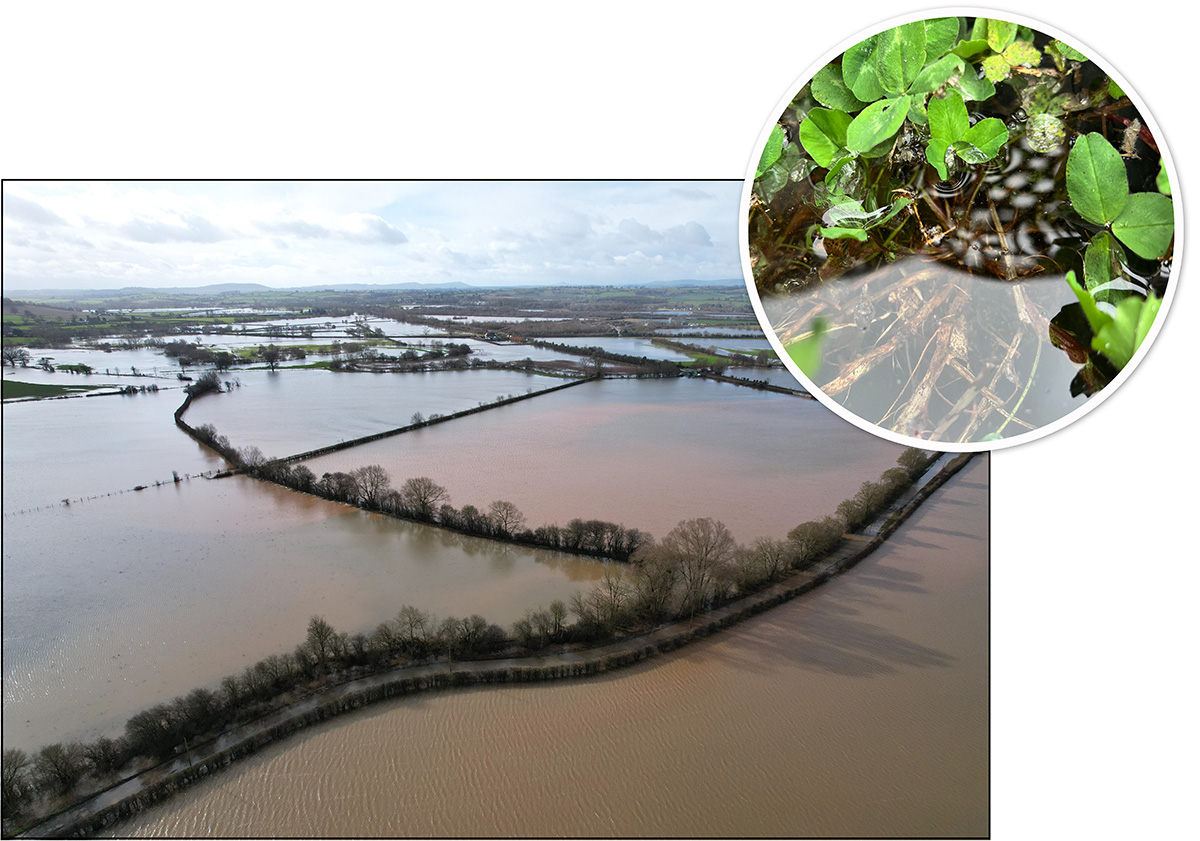
Image: Flooding negatively impacts UK agricultural production and legumes (inset) are particularly sensitive
How was the study carried out?
What did the researchers discover?
1. Flooding significantly reduces plant growth, but recovery is rapid.
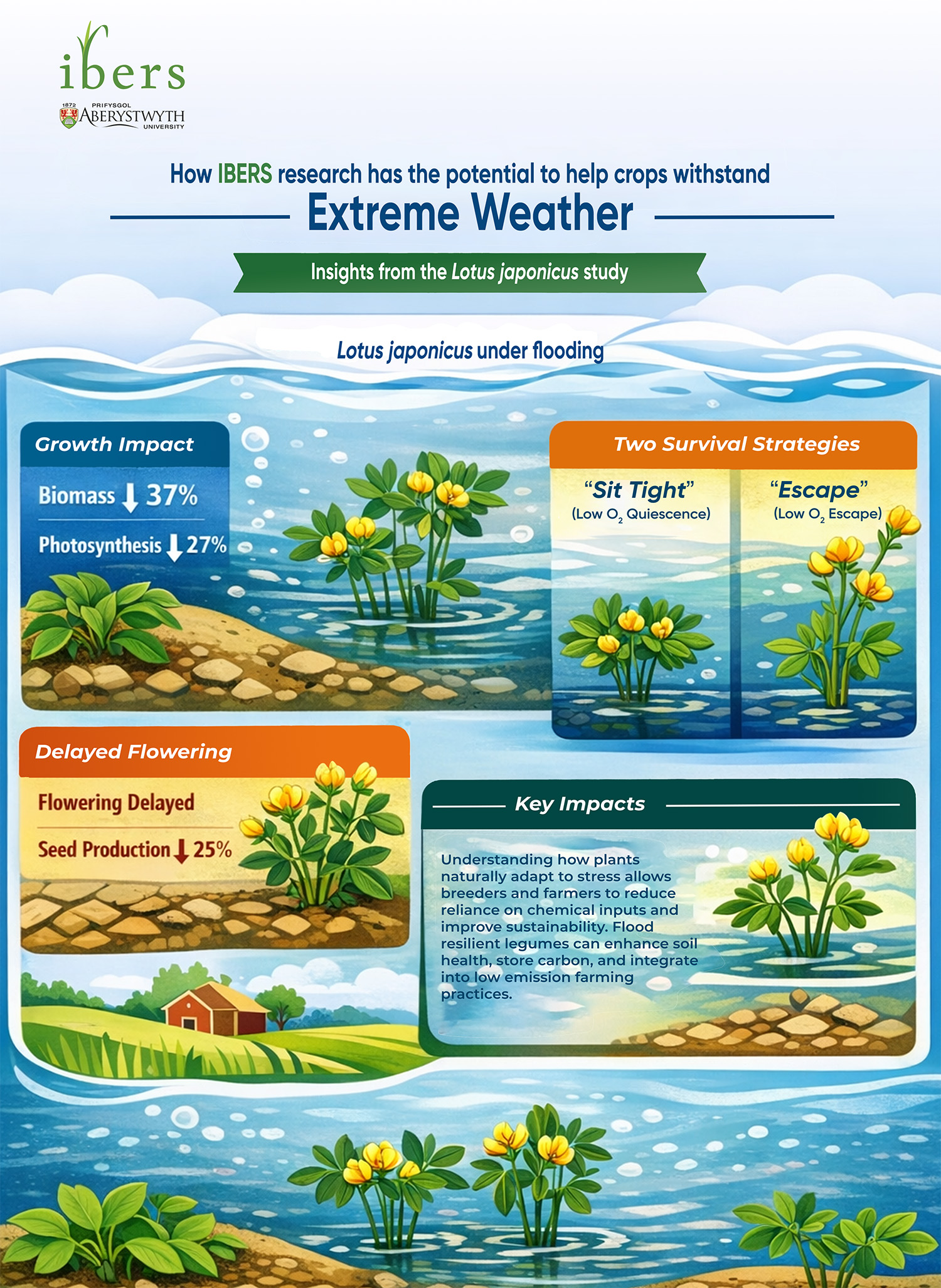
Across all varieties studied, flooding caused major declines in biomass (by nearly 37%) and reduced photosynthetic efficiency by over 27%. Yet despite these initial setbacks, each plant recovered its ability to photosynthesise within 10 days of the flood event. This suggests that Lotus japonicus possesses inherent climate resilience that could be harnessed in future crop breeding.
2. Flooding has profound and variable effects on flowering time
One of the most striking and novel findings of the study was the large variation in flowering responses following flooding.
Flooding delayed the onset of flowering by anything from half a day to more than three weeks, depending on the plant’s genetic background and region of origin. Overall, flower production was also reduced by nearly 25%.
Notably, plants originating from different latitudes showed markedly different responses, revealing a strong link between geographic origin and flowering sensitivity to flooding. The scale of this variation, observed across a relatively small number of genetic lines, points to a high level of genetic diversity in how legumes respond to environmental stress.
Because flowering time plays a critical role in determining yield and harvest timing, these findings are particularly important for predicting how future climate conditions may affect crop productivity. They also suggest that specific genes controlling flood tolerance and developmental timing could be identified, opening the door to further genomic research in legumes.
3. Plants use two different survival strategies.
The study also observed two well‑known plant responses to flooding:
- A “sit tight” strategy, where plants stop growing to conserve energy under low-oxygen conditions, termed low-O2quiescence syndrome (LOQS)
- An “escape” strategy, where plants elongate their shoots upward in an attempt to reach the water’s surface, known as low-O2escape syndrome (LOES)
Six accessions used the former strategy, while three used the latter. These different responses reflect evolutionary adaptations to local environments and could help guide breeders select traits best suited to specific regions and farming systems.
How does this research benefit society?
Looking ahead
Accessible Science
'Accessible Science' is an IBERS Knowledge Exchange initiative helping to highlight the significant impact that IBERS research has on addressing the global challenges of food security, dietary health and climate change. These articles are intended to ensure that research reaches beyond our laboratories and experimental field trials to deliver real benefits to society by engaging with policy makers, supply chains, agriculture, other industry partners and the wider public.