
First cosmic dynamo spotting reveals how magnetic fields created in space

Dr Owen Roberts, Department of Physics, Aberystwyth University
31 March 2026
Scientists have observed a natural cosmic dynamo operating in near‑Earth space for the first time – bringing them significantly closer to understanding how magnetic fields are created in the universe.
The discovery, made by an international research team led by the Space Research Institute of the Austrian Academy of Sciences and involving physicists from Aberystwyth University, sheds new light on one of the most fundamental energy‑conversion processes in the cosmos.
Much like the way in which human‑made generators convert motion into electricity, cosmic dynamos work by transforming the movement of electrically conducting gas or plasma into magnetic fields.
These dynamos are believed to power the magnetic environments of planets, stars, and galaxies, yet directly observing them in space has long remained out of reach.
The new study, published in Nature Communications, has identified clear evidence of a turbulent small‑scale dynamo inside Earth’s magnetosheath –the chaotic boundary where the solar wind slams into our planet’s magnetic field.
Constantly compressed, stirred, and reshaped by solar wind pressure, the magnetosheath provides the only known natural environment where scientists can directly probe dynamo behaviour in a collisionless space plasma.
This discovery brings scientists significantly closer to understanding how magnetic fields are generated and maintained throughout the cosmos – an essential process that helps shape the behaviour of the entire Universe.
Dr Owen Roberts, from the Department of Physics at Aberystwyth University, said:
“This is an extraordinary result. For the first time, we can see a natural plasma dynamo in action right on our cosmic doorstep. The measurements we take will help bridge the gap between laboratory experiments, computer simulations, and the real behaviour of space plasmas. Understanding how dynamo action works is essential for explaining the evolution of magnetic fields in planets, stars, and galaxies.”
The breakthrough was made possible using NASA’s Magnetospheric Multiscale (MMS) mission, a fleet of four identical spacecraft flying in a precise pyramid‑like formation. This unique configuration enabled researchers to capture simultaneous measurements of plasma flows and magnetic fields in three dimensions.
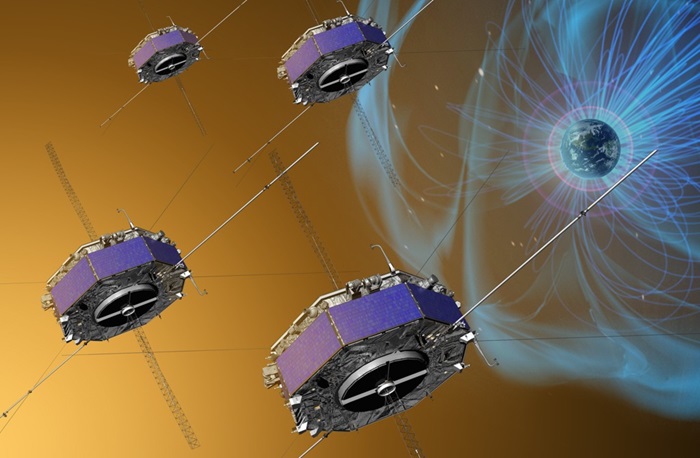
Artist depiction of the MMS spacecraft. NASA-GSFC
With this data, the team observed magnetic fields being stretched and folded by rapid plasma motions and regions where magnetic strength weakened and curved back on itself.
They also saw zones where magnetic intensity grew - exactly as dynamo theory predicts - and plasma instabilities that allow the dynamo to operate even in the absence of particle collisions.
These signatures match decades of theoretical predictions and computer simulations but have never been observed so clearly in space until now.
Dr Roberts from Aberystwyth University added:
“The four NASA spacecraft give us a 3D view of the turbulence, allowing us to observe magnetic fields stretching, twisting, and growing exactly as theory predicts.
“Being able to witness these mechanisms in action transforms what was once purely theoretical into something we can measure and test. It’s a breakthrough that will reshape how we study magnetic fields throughout the cosmos.”
Share


