
Aberystwyth scientists welcome European Solar Telescope milestone
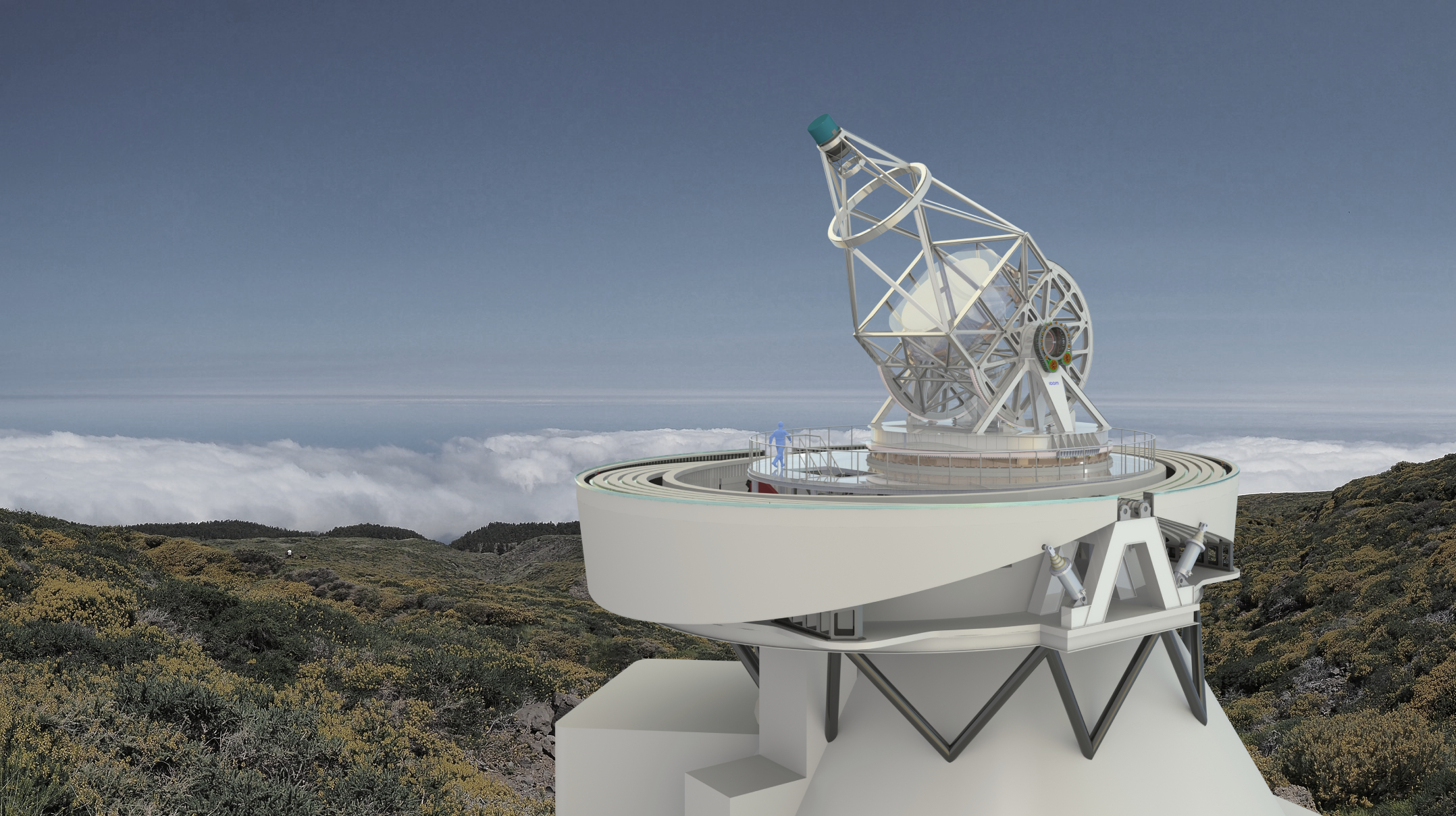
Design sketch of the telescope. Credit: EST.
09 October 2026
Scientists at Aberystwyth University have welcomed the news that the European Solar Telescope (EST), a major international project to study the Sun, has been granted Landmark status by the European Strategy Forum on Research Infrastructures (ESFRI).
The new designation recognises the scientific importance of the EST project, the progress made towards its construction, and the key role it is expected to play in Europe's research infrastructure landscape.
Featuring a 4.2-metre mirror and state-of-the-art instruments, the EST will be built at the Roque de los Muchachos Observatory on La Palma, Spain.
It will provide unprecedented observations of the Sun and its atmosphere, helping scientists better understand solar activity and the effects of space weather on satellites, communications systems and power infrastructure on Earth.
The EST is being developed by institutions from across Europe. Aberystwyth University is a member of the EST UK Universities Consortium, a partnership of leading UK research institutions supporting the telescope's development and future scientific programme.
Professor Huw Morgan, Professor of Solar Physics at Aberystwyth University, said:
“The EST will offer exceptionally detailed measurements of the Sun's hot atmosphere, allowing us to observe activity on scales that are beyond the reach of existing telescopes. The Space Physics group at Aberystwyth has a strong track record of advancing our understanding of the solar atmosphere, including the discovery several years ago of a magnetic field far stronger than had previously been expected.
“By revealing the Sun's atmosphere in greater detail than ever before, EST will help answer one of the biggest questions in space physics: how the solar atmosphere is energised.
“These observations will also strengthen our space weather research and our collaboration with the UK Met Office. A better understanding of the solar atmosphere will improve our ability to predict major solar eruptions and flares, helping us better understand events that can affect technology and infrastructure here on Earth.”
The EST project is coordinated by the European Solar Telescope Foundation, with support from the Instituto de Astrofísica de Canarias and research partners across Europe.
Dr Manuel Collados, EST Coordinator, said:
“EST is, by its very nature, a European project. No single institution or country could undertake an infrastructure of this scale and ambition alone. Its recognition as an ESFRI Landmark is therefore a recognition of the strength of the European partnership that has been built around the project. The task before us now is to turn that shared scientific ambition into the long-term commitments needed to bring EST into construction.”
Once operational, the EST will allow researchers to observe the solar atmosphere simultaneously at multiple heights and across different wavelengths, providing new insights into how magnetic fields emerge from the Sun's surface and how energy is transported through its atmosphere. Its observations will complement those of solar space missions and help scientists better understand the processes that drive solar eruptions and other phenomena that affect space weather.
AU23226
Share


