
IBERS at Aberystwyth to welcome the British Phycological Society Annual Meeting
12 December 2025
Aberystwyth, Wales – January 6th to 8th 2026
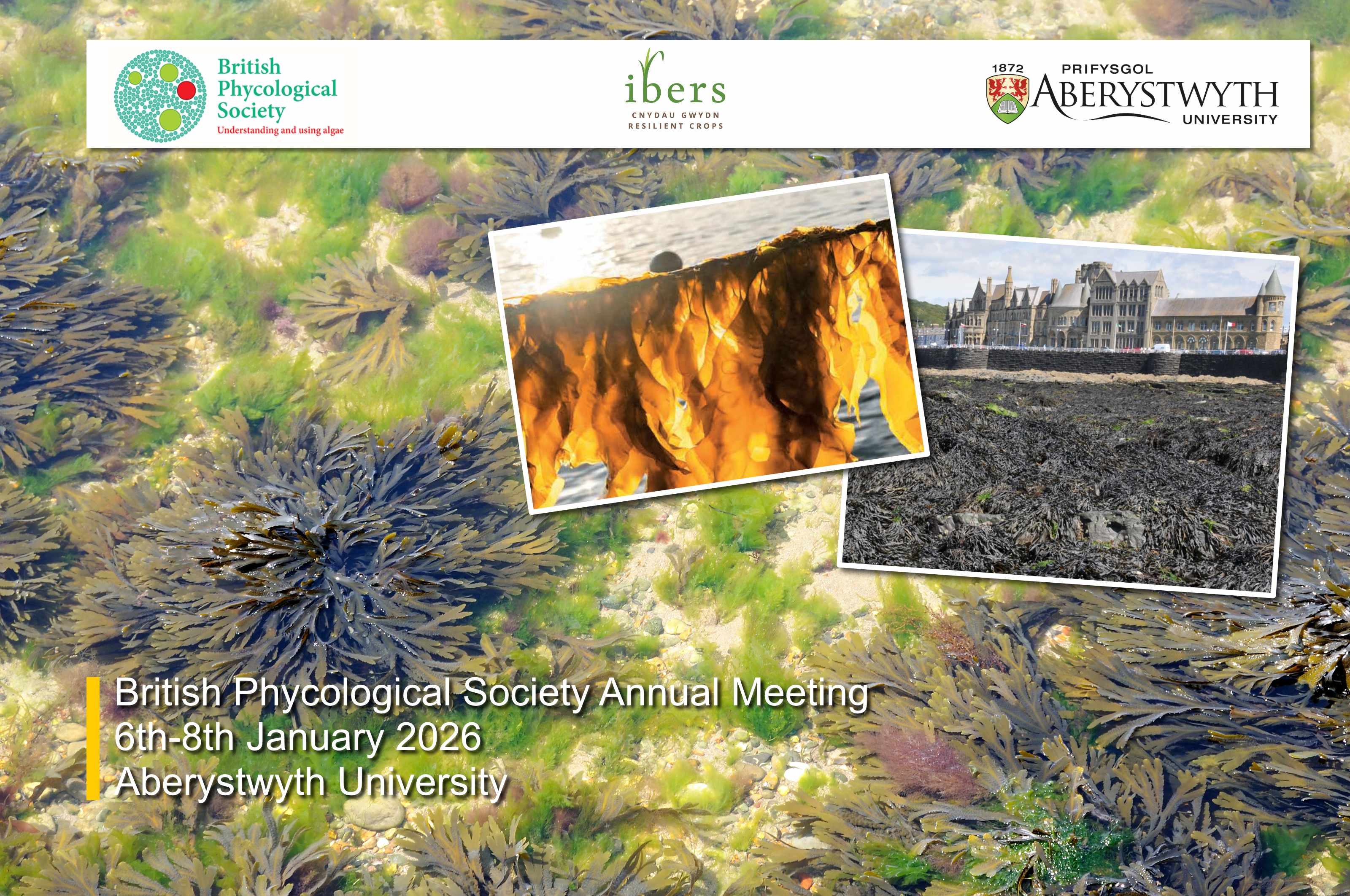
We are delighted to announce that IBERS at Aberystwyth University will host the Annual Meeting of the British Phycological Society from Tuesday 6th to Thursday 8th January 2026. The full programme includes scientific presentations, poster sessions, a student and ECR icebreaker event, the BPS AGM, and a conference dinner and ceilidh.
A public lecture, “Microalgae as light-powered cell factories for the bioeconomy,” will also take place as part of the meeting (January 6th 4-5 pm). The talk will be delivered by Professor Saul Purton, President of the British Phycological Society and Professor of Algal Biotechnology at University College London. Professor Purton is internationally recognised for his work on microalgal biology, molecular genetics and the development of algae as sustainable phototrophic production platforms for high-value compounds, bioactive molecules and novel biotechnological applications. In this lecture he will highlight some of the key discoveries and applications during his research career with a particular focus on how this work might benefit society in the near future. This public lecture is open to all, and members of the local community, students and staff are warmly encouraged to attend.
The meeting will bring together researchers working on the biology of algae and other aquatic photosynthetic organisms — a timely opportunity for IBERS to highlight how its research agenda aligns with the growing importance of aquatic and marine systems in sustainable agriculture, aquaculture and the wider bio-economy.
We are proud that IBERS researcher and President-Elect of the British Phycological Society, Dr Jessica Adams, will deliver a keynote address during the meeting. She said:
“I am very much looking forward to welcoming the phycological community to Aberystwyth. This meeting offers a wonderful platform for cross-disciplinary dialogue, bringing together biologists, ecologists and biotechnologists to explore how photosynthetic organisms can contribute to sustainable food, feed and bio-based resources. I’m excited to see how new collaborations might arise from this event.”
The 2026 programme reflects the breadth of modern phycological research. Sessions will cover topics such as diatom physiology, glacier algal blooms, carbon concentrating mechanisms, kelp forest ecology, algal biotechnology, protein extraction from seaweeds, and pilot-scale seaweed processing. Attendees will also hear about novel approaches to microalgal cultivation, thermal adaptation in kelp, and the use of algae for bio-based products and sustainable aquaculture. The meeting features split sessions to accommodate a wide range of research interests, poster presentations, and opportunities for students and early-career researchers to network at an icebreaker event.
Hosting this Society meeting at IBERS aligns closely with our core mission. IBERS is a leading research institute committed to ensuring humanity can sustainably produce the food, feed and plant-based industrial resources it needs. Our research focuses on making crops more resilient, improving quality, safeguarding genetic diversity, capturing carbon and understanding wider environmental impacts
Within this context, the study of algae and phycology opens promising pathways — from novel protein sources and enhanced carbon capture in aquatic systems to the bio-refining of algal biomass and improved ecological understanding of aquatic primary production. These areas complement and strengthen our long-standing expertise in terrestrial crop, grassland and bio-energy research.
We look forward to welcoming delegates from across the UK and beyond, showcasing our facilities, and supporting new collaborations in phycology, biotechnology, ecology and the bio-economy.
For more details and the full programme of the meeting, please visit the event website: https://aber.brphycsoc.org/wordpress/