
Grassland Research Platform
Grassland Research Platform
Our grassland research scientists, industrial partners, and farming networks are working to enhance the sustainability of grassland agriculture and help deliver net-zero food and farming systems by 2050. A total of 47 forage crop varieties (e.g. perennial ryegrass, red and white clover) have been developed that IBERS science has helped underpin and are commercialised by long-term commercial partners Germinal Horizon.
We work with industrial partners from across the agricultural supply chain and conduct participatory research with farm businesses to gain better insights into their real-world challenges, the barriers to change, and focus on the science that is most needed to better support our agricultural communities. Taking a whole farm systems approach, our multidisciplinary research teams work closely with farmers to help deliver more productive, resilient, and sustainable agri-food systems.
Currently livestock systems occupy about one third of available agricultural land globally, contribute to 40% of the value of agricultural outputs, and one third of the protein consumed by humans (FAO, 2019). Increasing demands for animal products and also plant-based alternatives are predicted to continue due to population growth and increasing consumption per capita.
There is an increasing need to better understand the impact of livestock farming on the environment and find ways to reduce its environmental footprint over the whole system. This includes the breeding of more resilient forage crops that are better tailored to ruminant diets. In addition, forage crops can be processed to provide feed for monogastric animals and pulses grown to provide alternative protein sources for animals and humans.
IBERS core research is centred on meeting the challenges of grassland farming and the science that underpins the breeding of new and improved varieties of forages, legumes, and energy grasses.
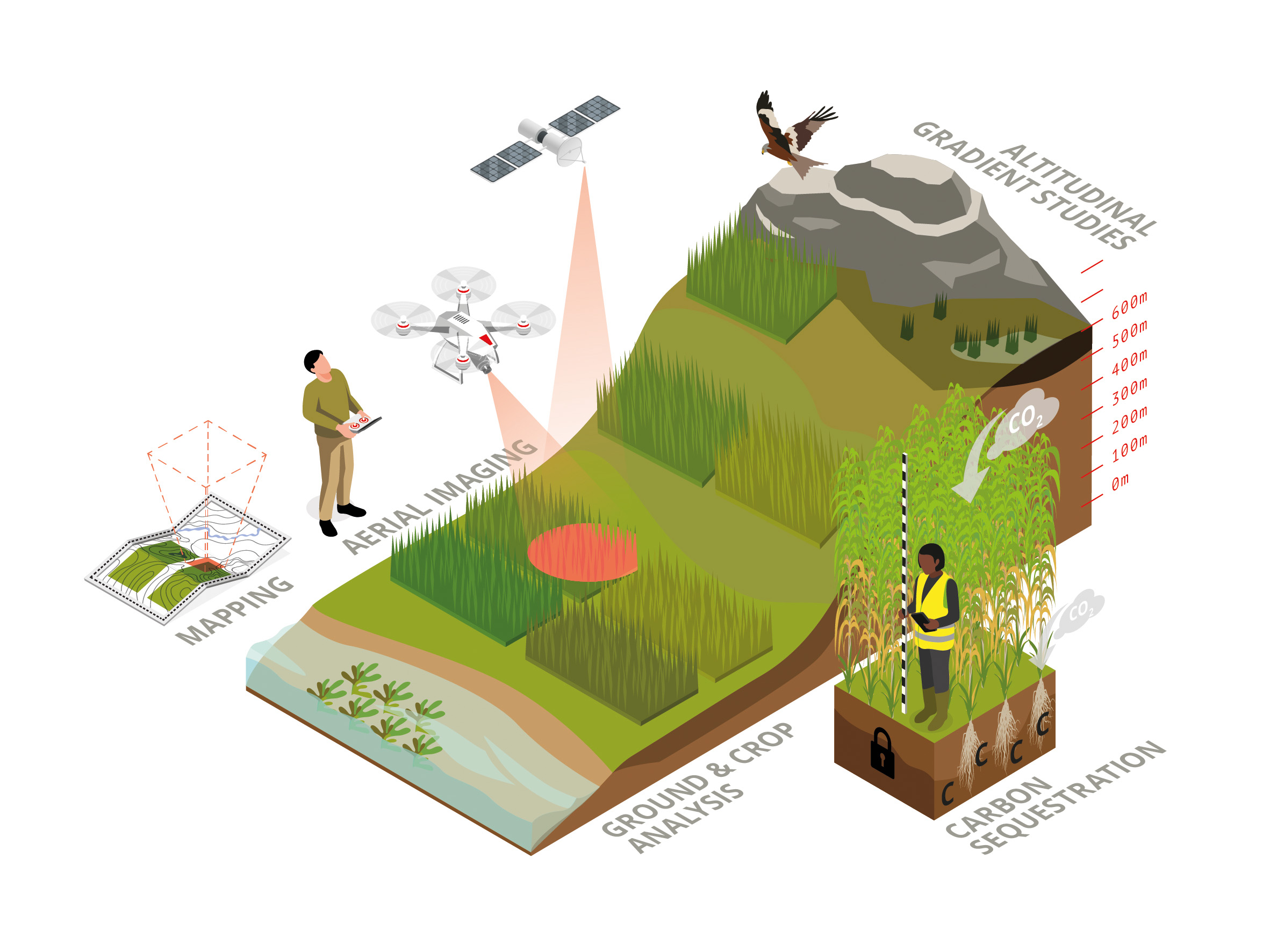
IBERS has access to over 1,000 hectares of grassland that is managed by Aberystwyth University and used for farming and environmental research. IBERS altitudinal gradient trials are spread across multiple sites and altitudes (0-600 m), selected to account for both upland and lowland systems and to be representative of 60% of all UK grassland growing conditions.
The experimental and observational datasets obtained from these sites, which include the Pwllpeiran upland research platform and Trawscoed farm, are critical to understanding crop resilience, untangling genetic and environmental influences on crop performance, and better understanding grassland agricultural systems. This long-term information is needed to provide a robust evidence base to inform policy in changing atmospheric, economic, and political climates.
Land Resources
The IBERS research farms based at Gogerddan, Morfa Mawr, Trawsgoed and Pwllpeiran provide a unique research platform extending over 1,000 ha, from 0-600 metres above sea level. In 2017, we established an altitudinal challenge gradient on four sites on Gogerddan and Trawscoed farms at 70, 140, 250 and 340 metres above sea level. These four sites exploit the geography of West Wales to provide a spectrum of environmental challenges that are broadly representative of the growing conditions of approximately 80% of UK grasslands. The sites have been instrumented and planted using diverse germplasm and can all be visited for measurements within a single day. Datasets are integrated with those from controlled environment-based approaches to gain biological understanding of persistence, resilience and performance. These instrumented plots have allowed IBERS to participate in the ESFRI EMPHASIS project, a pan European network of climatically diverse research facilities, to enable predictive breeding and research into future climates. In addition, the plots are used in the BBSRC Core Strategic Programme in Resilient Crops, the H2020 GRACE project, and data is being used to inform the modelling of biomass productivity in the EPSRC Supergen Bioenergy Hub at Aberystwyth and by other partners.
In 2020, IBERS reinstated the original Upland Centre at Pwllpeiran by taking on the lease for 190 ha of the contiguous (Ffridd) land from Welsh Government following its purchase from Defra. This complements an earlier £2.4M investment from BBSRC to support the development of Pwllpeiran as an upland platform. Pwllpeiran has a long history of involvement in upland grassland research, and in the late eighteenth century was host to the radical agricultural experiments undertaken by Thomas Johnes of the Hafod Estate. In the early twentieth century it then became the centre of George Stapledon’s pioneering Cahn Hill Improvement Scheme. Pwllpeiran now provides a grassland continuum from relatively good quality reseeded pasture, through permanent pasture and semi-natural rough grazing, to heathland and blanket bog. A Calan Gate electronic feeding system for small ruminants (the only such facility in the UK), can house up to 48 sheep, and there is capacity for 4 methane measurement chambers. Pwllpeiran is a microcosm for upland areas and is the only such facility in England and Wales. Its research is crucial to ensuring a robust evidence base for policies at a time of unprecedented political, economic and environmental change.