Migrant lives documentary scoops international award
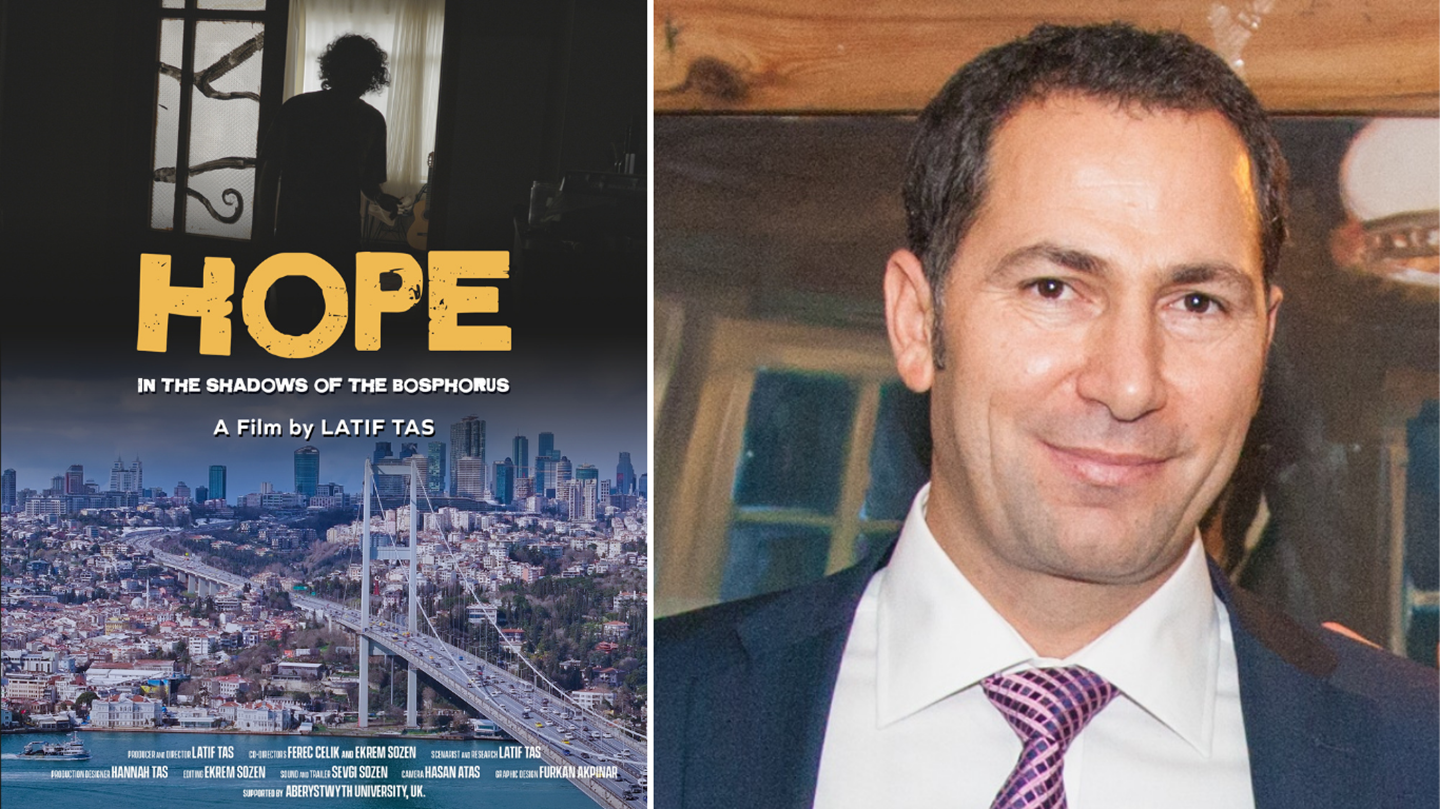
HOPE: In the Shadows of the Bosphorus / Dr Latif Tas, Department of Law & Criminology
20 February 2026
A new film which tells the personal stories of migrants fleeing to Istanbul has won an international award ahead of its release in April this year.
Directed and produced by Aberystwyth University research fellow, Dr Latif Tas, the new documentary, ‘HOPE: In the Shadows of the Bosphorus’, gives an insight into the lives of different internal and external migrants and long-standing residents in Turkey’s largest city of 16 million people.
Turkey hosts one of the largest refugee populations in the world, with 3.1 million people living there from war-torn Syria alone. The country has also seen significant immigration as a result of conflicts in Afghanistan, Iraq, Libya and Ukraine.
As a former resident of the city and an academic who is researching immigration in Turkey and the UK, Dr Tas says that many of the dynamics playing out on the streets of Istanbul are like those in other major cities including London, Paris, Berlin and New York.
His portrayal of immigrant stories and people’s reactions to migration has now won the Best Jury Choice Award at the ARFF International Amsterdam Film Festival, as well as short-listed for award by Manchester Lift-Off Film Festival 2026.
Reacting to winning the Amsterdam film award, Dr Tas from the Department of Law and Criminology at Aberystwyth University, said:
“It is a great honour for me to win and for migrant’s stories to be heard and recognised internationally. Especially after putting so much time and effort into this limited budget project with a dedicated small team.
“This film is not designed to make a political statement or be propaganda – it’s just telling real people’s stories in their own words. I’m silent throughout the film, just letting different characters, the combination of the hosts and migrants, in their own environments, to express their views and perspectives.”
Giving a preview of the film, Dr Tas added:
“We hear in the film people complaining about migrants taking jobs, but we also hear stories of migrants living in unbearable conditions. We have host people who welcome migrants and we also have migrants who carry their roots wherever they go. Some migrants would face persecution or even the death penalty if they returned to Iran, Afghanistan or Syria, where they originate from. I hope the documentary will help people ponder how we can manage these changes and challenges and how we can understand one another’s stories.
“Istanbul is a city that belongs to everybody but also nobody. In many ways Istanbul has always been a hub for people across the world, from Romans to Ottomans. In modern-day Turkey, there are millions who have fled internally from different Anatolian's cities, especially from Kurdish regions for decades escaping long internal conflict, and from Syria and tens of thousands from other neighbouring countries who have endured conflict or political difficulties. While the levels of immigration may be higher because of Turkey’s proximity to so many war-torn countries, this is not just a story about Istanbul, but one felt by many major cities across the world.”
An Aberystwyth University 150th Anniversary Award winner, Dr Tas has published two books about the role of informal justice in migrant communities and how minorities live under authoritarian regimes. He has held important international positions and won awards, including as a member of the Princeton Institute for Advanced Study and winning a Marie-Curie Global Award.
Dr Tas has interviewed hundreds of migrants over the years, from different economic, social and political backgrounds, in refugee camps, transit zones, safe houses, police stations and in wealthy neighbourhoods. He added:
"My interviews for academic work always had a deadline, an angle, a word count. I was often left with the uneasy feeling that I’d captured a fact, not a person. This film is, in part, a response to that limitation.
“My worldview is shaped by both scientific inquiry and creative empathy. I bring to this story a double lens: from journalism and science, I bring a commitment to truth, accuracy, and systems-thinking, the ability to connect micro stories to macro structures. From the arts, I’ve learned to slow down, to notice, to dwell in uncertainty. Where an academic might ask 'what caused this?', an artist can ask 'what does it feel like to live this?' This duality shapes how I approach the camera, not as a weapon or a spotlight, but as a mirror, a collaborator, a witness. My work is grounded in deep listening and relational ethics, not extraction. Migrants are not case studies or metaphors in this film, they are narrators, authors, and co-creators of their own stories."
Supported by Aberystwyth University’s Impact Fund, ‘HOPE: In the Shadows of the Bosphorus’ will be officially released in April 2026.
AU5426
Share


