
A Welsh contribution to the next phase of Mars exploration
When the European Space Agency’s Rosalind Franklin rover eventually begins drilling beneath the rust‑red surface of Mars, part of the mission’s scientific “eyes” and decision‑making systems will trace their origins to Wales.
For more than 15 years, Aberystwyth University has been playing a role in ExoMars, ESA’s flagship mission to search for signs of life on the Red Planet. Drawing on world‑leading expertise in physics, computer science and robotics, researchers in Aberystwyth have helped design, build and calibrate key instruments that will determine where the rover drives, what it analyses, and, ultimately, how humanity searches for life beyond Earth.
Searching for signs of life
Dr Matt Gunn, Senior Research Fellow in the Department of Physics, first became involved in the ExoMars project in 2010. He explains how the mission builds on – and goes beyond – earlier Mars exploration:
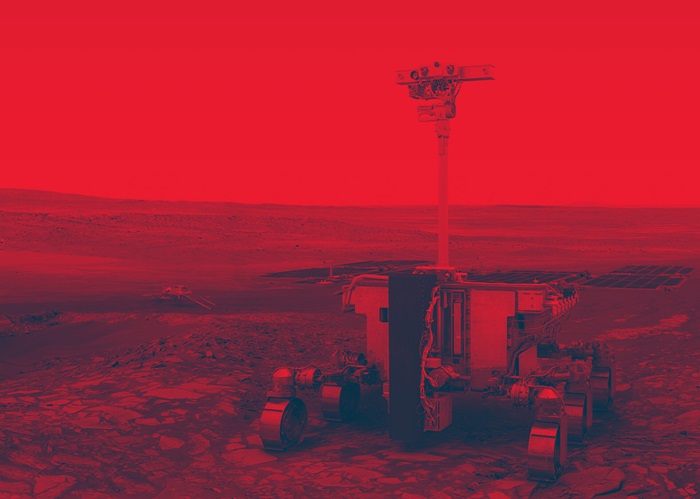
“Most missions to Mars have essentially been robotic geologists, helping us understand how the Martian surface formed and evolved. But the Rosalind Franklin rover is different: its core purpose is to search for signs of past or present life.
“We don’t expect to find anything on the surface because radiation would have destroyed organic molecules long ago. However, even a relatively short distance below the surface, the soil provides enough shielding for potential biosignatures to survive.”
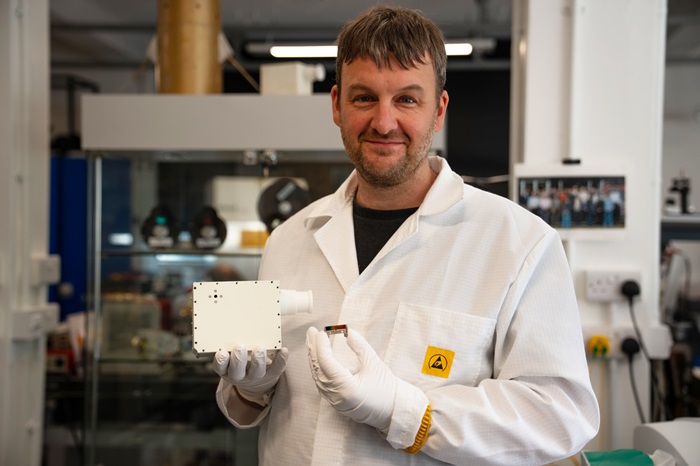 Dr Matt Gunn
That scientific ambition is what makes ExoMars unique, says Dr Helen Miles from the Department of Computer Science:
“What makes the Rosalind Franklin rover special is that it carries a drill to collect and analyse subsurface samples. No previous Mars rover has drilled up to two metres below the surface of Mars, and that depth allows us to extract samples nobody has ever seen before and to investigate what’s happening beneath the planet’s sun‑baked crust.”
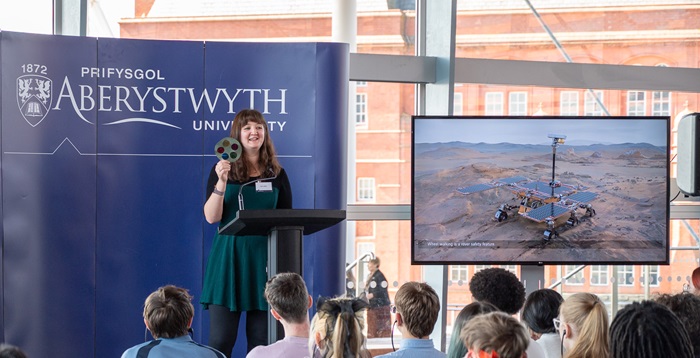 Dr Helen Miles
The eyes behind the search
Mounted atop the rover’s mast is PanCam, the panoramic camera system led by University College London’s Mullard Space Science Laboratory. Dr Gunn, who worked on some of the early technical development for the camera system, explains the concept:
“PanCam is a multispectral camera, meaning it can see far more colours of light than the human eye. While we see only in red/green/blue, PanCam uses eleven filters across the visible and infrared. This allows us to distinguish different rock types far more precisely than we could by eye alone.”
Following Russia’s full-scale invasion of Ukraine in 2022, collaboration with Roscosmos was cancelled, leaving a significant gap in the rover’s scientific capability. Later that year, the UK Space Agency backed an ambitious proposal from the Aberystwyth University ExoMars team to develop a replacement instrument in Wales. The Agency committed £10.7 million to the creation of a new spectrometer, recognising that restoring the rover’s full scientific capability was essential ahead of its rescheduled launch in 2028.
For the last four years, Aberystwyth University has led the development of ‘Enfys’ — Welsh for “rainbow” — an infrared spectrometer designed to work hand‑in‑hand with PanCam.
Together, PanCam and Enfys form the rover’s scientific “eyes”, helping scientists decide where to search for the most promising signs of life. They will detect minerals such as clays and other water‑formed materials that, on Earth, are known to preserve organic compounds and could point to ancient microbial activity.
 PanCam and Enfys. Credit: ESA
Dr Matt Gunn, Principal Investigator for Enfys, explains:
“Life as we know it always evolves in the presence of liquid water. While we don’t expect to find liquid water on Mars today, we can detect minerals that only form in watery environments.
“PanCam and Enfys will help us to identify those hydrated minerals from a distance, guiding the rover to the most promising locations to drill – locations where evidence of past life is most likely to survive.”
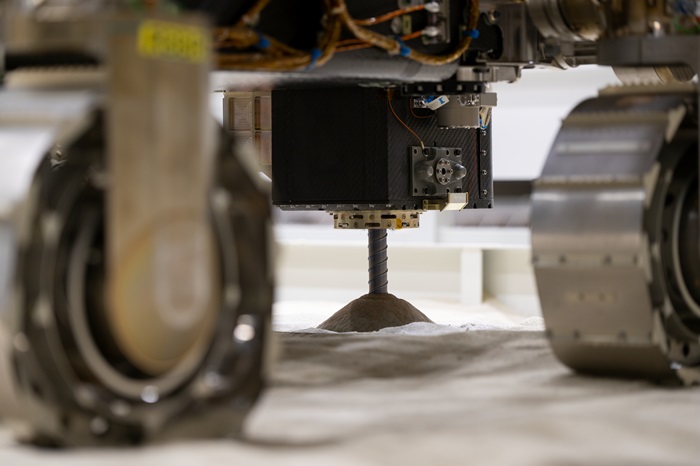 Credit: ESA – S Corvaja
Interpreting the images
PanCam will return high‑resolution colour and stereo images of the Martian landscape, allowing scientists to read the geology, identify ancient water-shaped environments, and place all other measurements into their wider environmental context. Enfys will complement this by providing infrared spectra to aid mineral identification.
To extract scientific meaning from those images, careful calibration and interpretation are essential.
Credit: ESA
Dr Helen Miles, Operations Software Lead for the Enfys instrument, is leading the development of software to analyse and interpret the data sent back from Mars:
“Our team is writing software which will correct for small imperfections or environmental effects in the PanCam images. That will help geologists and planetary scientists to see Mars as it really is, rather than artefacts introduced by the camera or by Martian conditions.
“We are also working with the spectral data from Enfys and exploring how it can be combined with PanCam imagery to give a much richer picture of the chemical composition of Martian rocks.”
“Providing scientists with tools they can use in near‑real time will be vital, because it will help them decide where the rover should drive next and which samples to collect.”
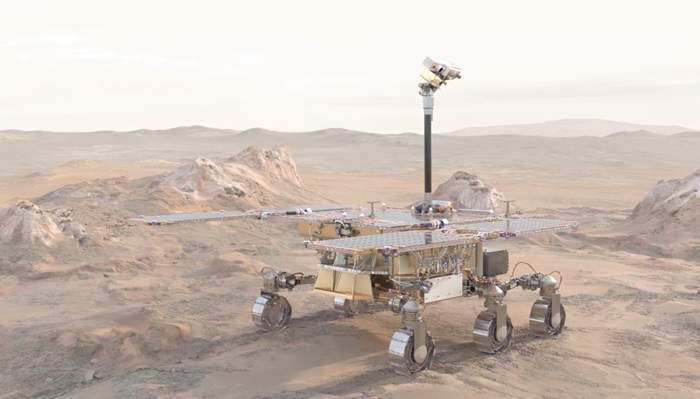 Credit ESA-Mlabspace
Engineering for an extreme environment
Exploring Mars comes with formidable technical challenges. Extreme temperatures, pervasive dust and powerful dust storms can degrade instruments, interfere with moving parts and limit power generation.
Dr Gunn explains:
“One of the biggest engineering challenges is the temperature range on Mars. Instruments on Earth usually operate between room temperature and slightly below freezing. On Mars, temperatures can swing daily from about +20°C to –120°C.
“Technology hates the cold, so we’ve had to design and test Enfys to survive down to –120°C and operate reliably from –50°C.”
Dust poses another persistent problem:
“Everything on Mars gets covered in a fine red dust and nothing washes it away — there’s no rain. That will affect not just the rocks we’re measuring, but also our calibration targets and even the rover’s solar panels.
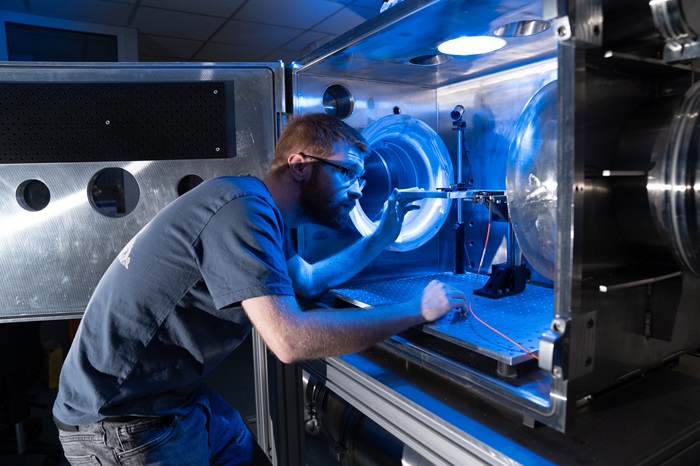
“To address this, we use a specialised wind tunnel in Aberystwyth that replicates Martian conditions. We expose calibration targets and rock samples to Mars‑analogue dust and study how it alters our measurements. That work is essential for developing processing tools that will allow us to extract accurate science from real Martian data.”
A collaborative effort
ExoMars is a highly collaborative international endeavour, involving specialist teams working on instruments, locomotion, power systems and mission operations.
The development and testing of Enfys is led by Aberystwyth University, with support from Mullard Space Science Laboratory (MSSL) at UCL, STFC Rutherford Appleton Laboratory and Qioptiq Ltd.
Dr Gunn says:
“Enfys is a challenging project as we are developing a completely new instrument on a very compressed schedule. However, we have a fantastic team of skilled and innovative people who are solving problems as they arise, and working together to get the instrument built and tested as quickly as possible.”
A question that has shaped generations
So, what does it feel like to work on a mission that could help answer one of humanity’s most enduring questions?
Dr Miles reflects:
“This is an incredibly important mission, and it’s hugely exciting that Aberystwyth University is part of this international venture. We’ve sent rovers and landers to Mars before, and we’ve learned so much from the data they’ve sent back, but we haven’t until now had a mission specifically designed to search for signs of life.”
Dr Gunn adds:
“We still don’t know whether Earth is the only planet in the Universe that has ever hosted life. If we were to find signs of past or present life – even very small organic molecules – on our neighbouring planet, that would be a really significant discovery, and would basically answer the question of whether we are alone in the Universe.”
 Credit: ESA
Further Information
Use the following links to find out more about the ExoMars mission:
Get in touch
As a University, we’re always keen to share our knowledge and expertise more widely for the benefit of society. If you’d like to find out more or explore how you can collaborate with our researchers, get in touch with our dedicated team of staff in the Department of Research, Business and Innovation. We’d love to hear from you. Just drop an e-mail to: