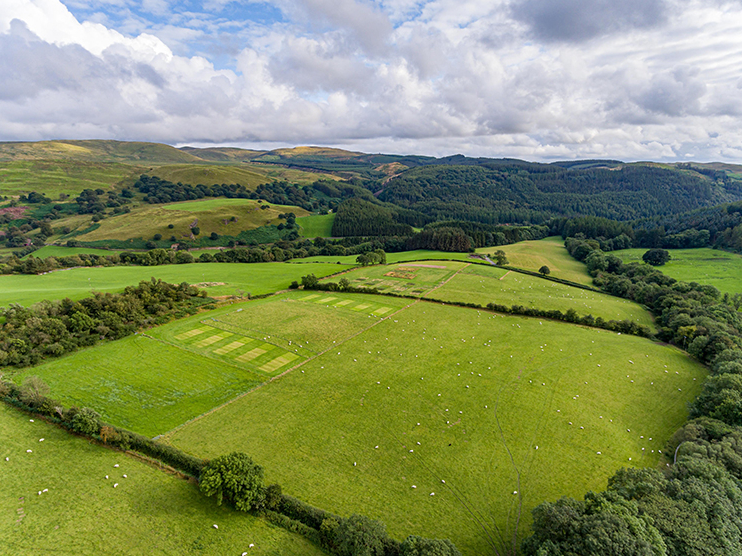
Institute Strategic Programme Grant (ISPG) - Resilient Crops
Why Ryegrass and Clover for Forage?
Grasslands (pasture and rangeland) represent two thirds of UK agricultural land. The dominance of grasslands means that they are important to the delivery of agricultural products and environmental services to a very sizeable area of the UK.
Ruminant agriculture is highly reliant on grassland and generates production value of ~£8.3 Bn pa.
Genetics and Genomics of Persistence and Resilience in Perennial Ryegrass and Red Clover
Perennial ryegrass is the most widely sown forage grass within the UK due to its ability to form productive swards which support grazing-based ruminant agriculture. When used in combination with forage legumes, such as red and white clover, these mixed grasslands can provide both a high energy and protein feed and allow for fewer inputs, due to the nitrogen-fixing properties of the legumes. However, the increasing variability of the climate means that the individual plants which make up these mixed grasslands must be able to persist in the face of a wider range of environmental challenges. Our research is aimed at identifying some of the genetic components of persistence and resilience in these grassland species.
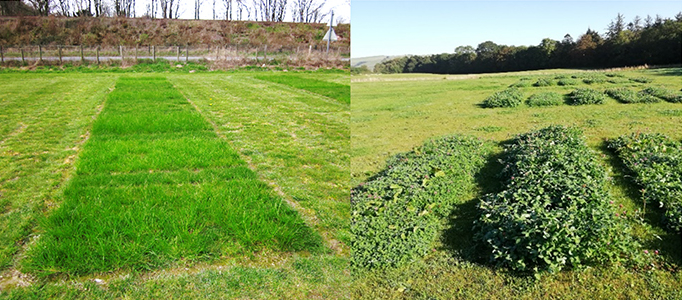
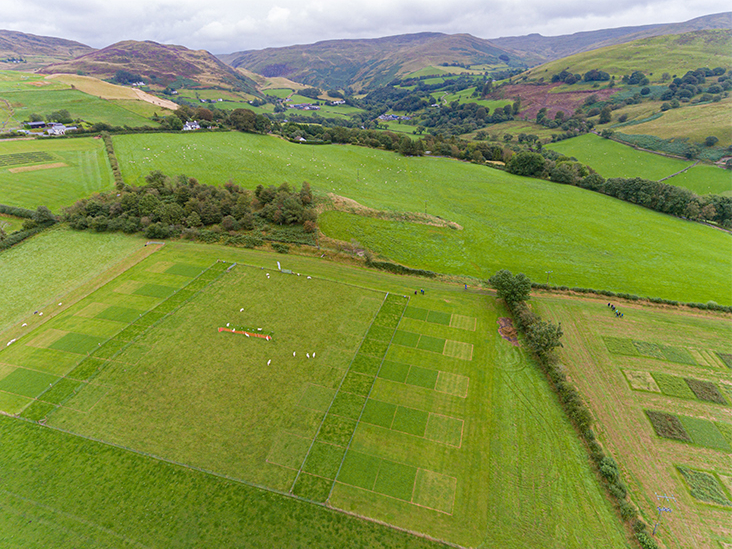
Field plots of perennial ryegrass and red clover at Aberystwyth
Approach: Our approach involves using some of the considerable genetic resources that exist for ryegrasses and clovers to generate novel populations which show interesting variations in trait performances. For ryegrass we are using experiments on individual plants in controlled environments which look at response to water-logging and drought, combined with field based analyses of population performances, i.e., plants grown in dense swards. The results of these trials will indicate genes and genomic regions which may play important roles in conferring persistence and resilience in the face of abiotic stresses. For red clover, we have identified germplasm with contrasting growth habits ranging from erect to prostrate or even creeping, where roots form from nodes of shoots lying on the surface. The erect growth habit is chiefly a result of breeding, while the prostrate habit tends to be associated with natural populations or ecotypes. We believe that growth habit determines how well the plant is able to cope with the selective pressure of grazing or frequent cutting and have generated populations which are derived from crosses between erect versus prostrate growth habit which will allow us to identify key genes in controlling this trait.
Potential impact: Grasslands cover c. 70% of the utilised agricultural area within the UK and, therefore, have a major impact on many aspects of our environment. Because of the extent of these grasslands, incremental improvements in the performance of individual grass or clover plants could generate considerable benefits. For instance, longer-term persistence of mixed grass and legume swards and improved resilience in the face of environmental stresses can result in the need for fewer interventions to maintain or renew the grasslands, thus generating more stable natural environments with lower energy costs.
Key research insights and findings: We have generated populations of ryegrasses and clovers of varying genetic complexities which have been sown as experimental plots in the field. The unusual heat and drought during the summer of 2018 meant that these plots were also exposed to considerable abiotic stress during establishment. Work at the moment is characterising whether the conditions during this field establishment affected the balance of individuals and genes within these populations.
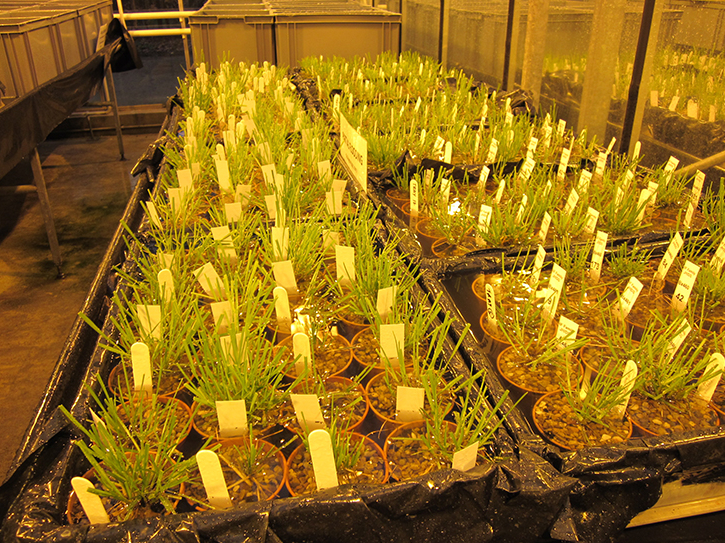
We have evaluated c. 200 individual ryegrass plants taken from genetic resources collections in controlled environments for their responses to drought and water-logging. This has allowed us to identify individuals for further study which will be used in controlled crosses to generate populations for further analysis.
Upland Grasslands
We aim to identify and characterize genes associated with interspecies competition in grassland, and to characterise the genetic and physiological responses of key grassland species to grazing, cutting and other biotic and abiotic stresses.
Approach: We use techniques across different scales including DNA-barcoding, plant neighbour analysis and remote sensing to track the spatial flux of constituent species under different management regimes and across a climatic transect. We are using epigenetic profiling of plants exposed to different stressors in a field environment, and NGS DNA barcoding on faecal samples/offcuts to determine species-specific biomass removal.
Potential impact: We will identify plant responses underpinning resilience to grazing/cutting in the context of competing multi-species swards. In the short term, we will allow improved assembly of commercial species and varietal mixtures tailored to both the growing environment and grazing regime. In the longer term, we will improve forage grass and legume varieties that are more compatible with each other and resilient to grazing/cutting.
Key research insights and findings: Our initial work focussed on developing new approaches to detect changes in sward species composition during establishment or in response to management/climatic variables. We optimised two low cost, high-throughput alternatives to DNA metabarcoding (targeted PCR-RFLP and PCR-HRM) thereby increasing the potential statistical power of sward flux studies. Combined use of all approaches enabled us to process far more samples than by metabarcode-tag-labelling alone. These strategies are now being combined to describe sward dynamics during establishment and will next be used to characterise swards in response to management and across an altitudinal gradient broadly representative of >60% of UK grazing land.
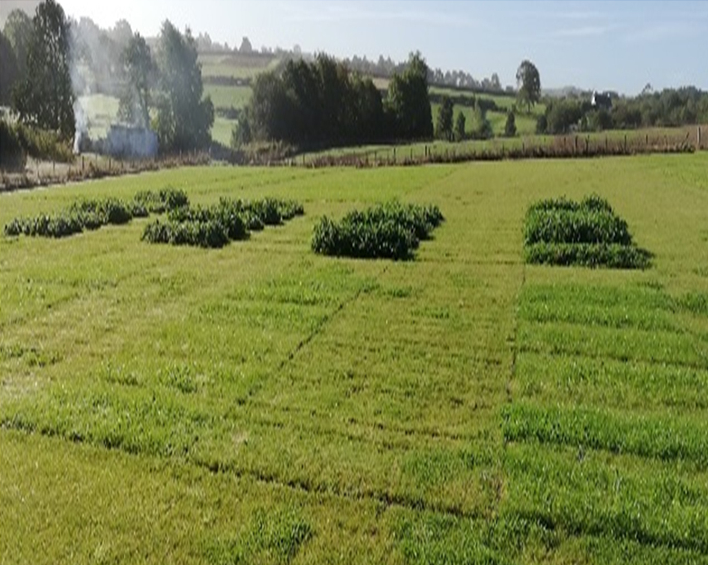
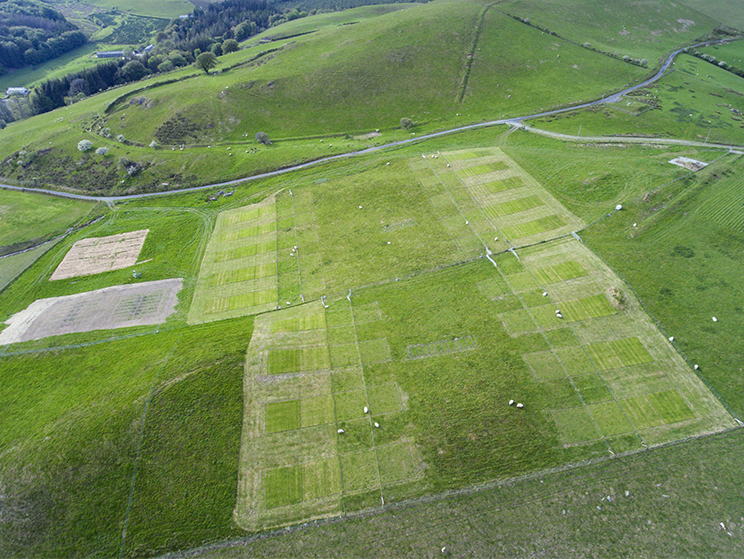
Two contrasting commercial seed mixtures optimised for lowlands and uplands were established across a gradient of the four altitudinal sites. Each site contained five replicated blocks for two contrasting seed mixes (10 blocks in total). Each block was subdivided into sub-blocks (7m x 7m) that were subject to one of four grazing regimes (continual grazing, rotational grazing, simulated grazing and hay cut). Reference plants have been collected from all sites and used to create local reference barcodes suitable for all profiling techniques (core barcodes plus many supplementary loci). To establish species compositions point quadrat samples and pooled point quadrat samples were collected during and then following sward establishment.
 |
 |
|
|---|