
Institute Strategic Programme Grant (ISPG) - Resilient Crops
Why Miscanthus for Bioenergy and Biorenewable Feedstock?
The UK government has outlined plans to achieve a netZero CO2 economy by 2050. Plants fix CO2 from the atmosphere and play an essential role in meeting emissions targets via bioenergy and biorenewable feedstocks.
The Energy Technologies Institute estimated that the costs of the UK energy system would be up to £44 Bn higher per year by 2050 without bioenergy.
Optimising Biomass Yield
Miscanthus is a new highly productive long season biomass crop used as a source of biorenewable energy and industrial bioproducts. To improve yield we are investigating the genetic and physiological mechanisms that control development in Miscanthus, including crop establishment, early season growth and late season senescence.
Approach: We are taking a holistic approach toward optimising crop development and yield across the entire growth period. We manipulate seed and seedling biology, we model yield across different sites to determine Genotype x Environment interactions and we analyse growth and developmental traits to identify successful ideotypes. We are using this knowledge to assist the Miscanthus breeding programme at IBERS. We are using hybrids in mapping families and genome wide association trials to identify loci and marker combinations associated with our traits of interest. We also use long term trials to determine variation in yield, nutrient flux and carbon flux to determine the potential impacts of growing Miscanthus.
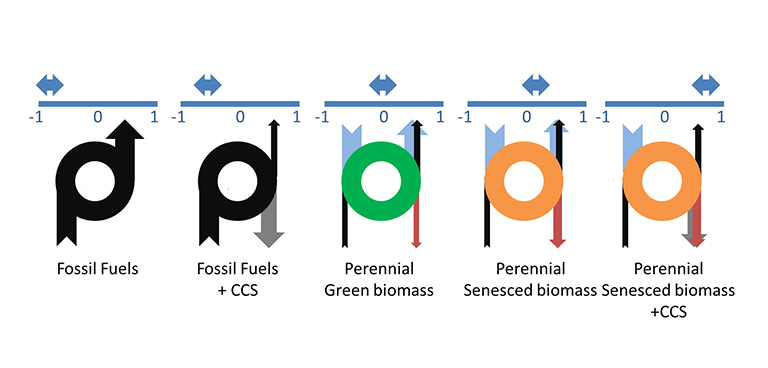
Potential impact: The NetZero report and other reports outlining the progression and potential impacts of climate change demonstrate the need to capture carbon from atmosphere now. Our programme is contributing to the accelerated domestication of Miscanthus as a leading, fast growing, high yielding crop that captures CO2 from the atmosphere. We use one of the largest diverse collections of Miscanthus to define ideotypes for different environments and end-uses in bioenergy and industrial biotechnology. Our programme delivers global impact across many different growing regions and commercial sectors.
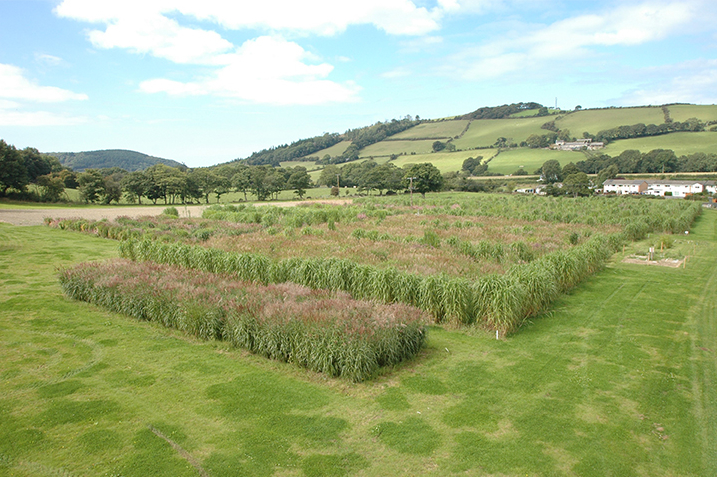
Key research insights and findings: We have focussed on optimising year 1 growth of Miscanthus. Miscanthus is normally established from rhizome but we have developed and field tested new propagation methods (Ashman et al., 2018; doi.org.10.1111/gcbb.12518). This allows greater and faster uptake of the crop.
We have identified an optimal index of early season traits for efficient selection (Davey et al., 2017; doi:10.1093/jxb/erx339). We have extended this work to identify selection indices to demonstrate the potential gains in breeding programmes from multiple trait selections including late flowering and crop quality traits (Slavov et al., 2019; doi:10.1093/aob/mcy187). Use of these indices allow more focussed selections to be made in breeding.
We have identified the impact of flowering control on seasonal of yield and interactions with senescence and crop quality (Jensen et al., 2017; doi: 10.1111/gcbb.12391). We have identified a number of QTL associated with flowering and studied syntenic regions with other crops and identified a loci in common from switchgrass. This provides genetic markers to select for a key biomass trait.
We have demonstrated that some environmental interactions that affect flowering are different between perennials and the more commonly researched annual species. Our work shows the importance of biomass flux in controlling development in perennials and highlights the differences between annual and perennial systems.
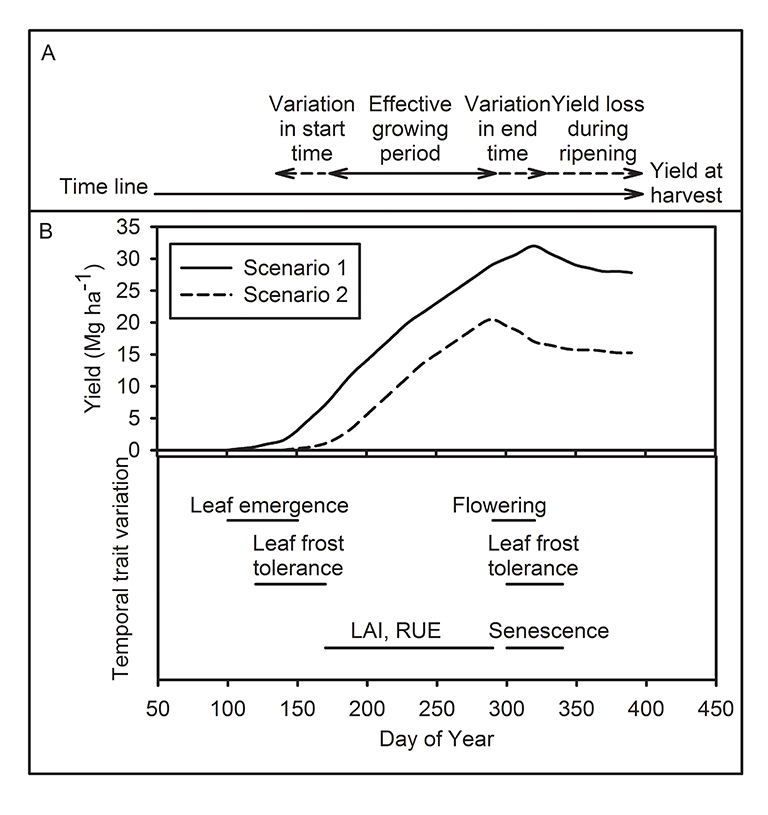
We have identified how stem growth development varies across diverse populations. Fast growing plants grow for shorter periods indicating a seasonal limit to yield may exist (Robson et al., 2019; doi:10.1111/gcbb.12610). Our improved understanding of the perennial control of seasonal growth will allow optimal strategies for yield improvement to be developed.
We have established the trends across long term yield trials of up to 14 years using different high yielding hybrid Miscanthus. We have demonstrated that after planting levels of soil organic carbon are quickly replenished and sustained over the long term (Holder et al., 2019; doi:10.1111/gcbb.12624). This work illustrates the benefit of using perennial crops that establish stable soil ecosystems.
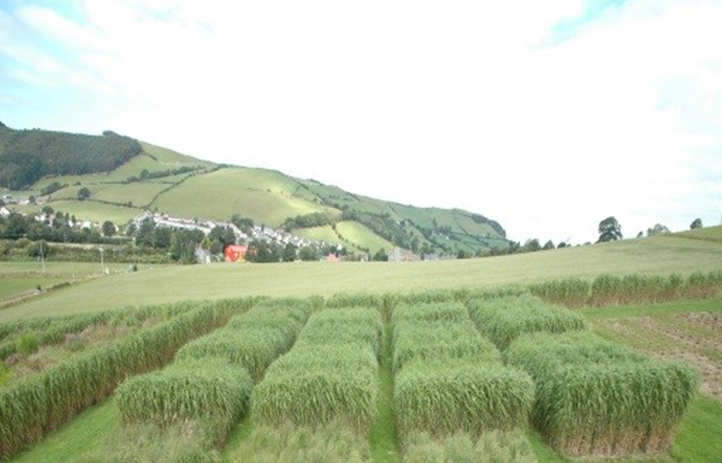
Plots of commercial Miscanthus used to analyse stem growth dynamics (Robson et al., 2019), long term yield trials and analysis of carbon flux in different agricultural systems (Holder et al., 2019)
Resilience to Stress
We aim to determine the molecular and physiological mechanisms that can make Miscanthus resilient to environmental stresses, including water and nutrient limitation. Both the plant genome and the plant microbiome are being investigated to optimise resilience traits. These combined approaches will generate an understanding of Miscanthus biology that underpins performance under multiple stresses at different life stages, and enable modelling for resilience under different climate scenarios.
Approach: Miscanthus genotypes are being subjected to nutrient and water stresses, in both controlled environment experiments and in the field, and the phenotypic, physiological and gene expression responses analysed. Plant growth promotion by novel bacterial endophytes is being tested under limited nutrient and water regimes. Resilience is considered in terms of both biomass yield and quality.
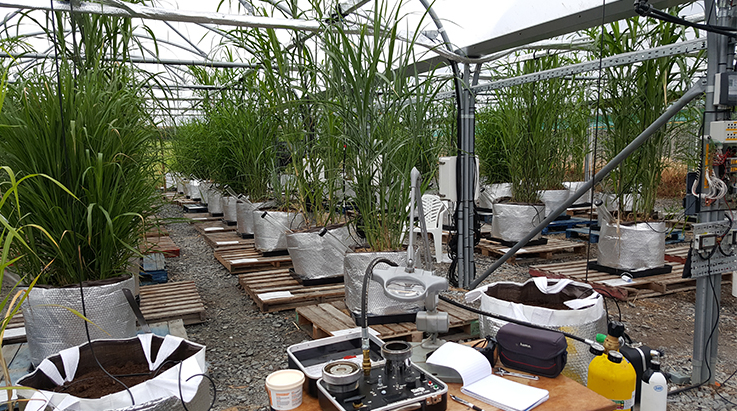
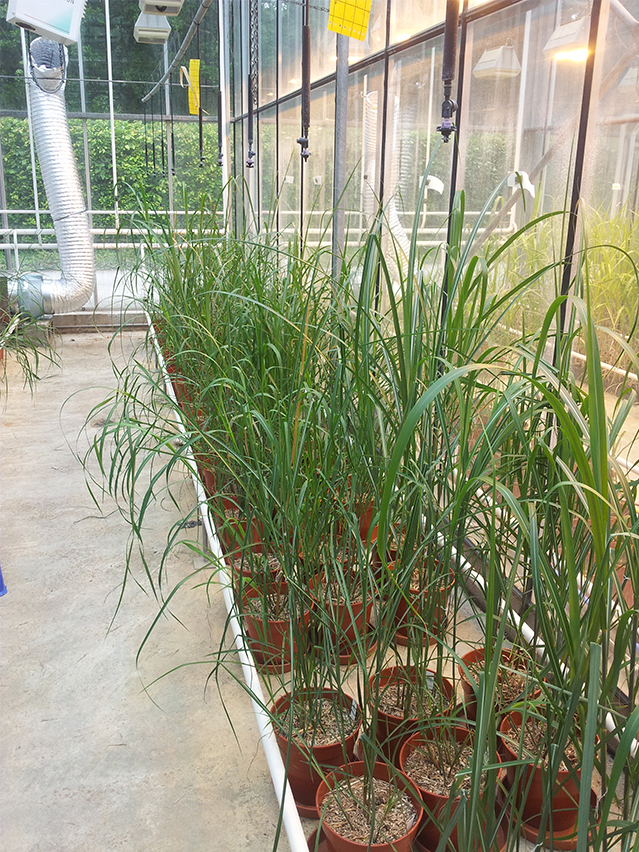
Potential impact: This work will contribute to the accelerated domestication of Miscanthus; to the definition of future ideotypes, including optimised plant-microbe interactions; and to the development of novel biomass varieties with improved resilience for different UK environments.
Key research insights and findings: We aim to understand the biology underpinning environmental stress responses at different life stages and to increase crop resilience for biomass quantity and quality. To address this we have subjected Miscanthus genotypes and model species to environmental stresses, alone and in combination to determine the mechanistic regulation of performance and resilience; and we have established 5 Miscanthus genotypes at 4 field locations along an altitudinal gradient from 70 to 340 m elevation.
We have identified a number of genotypes that retain higher yield than M. x giganteus in control and drought treatments, highlighting the potential for developing high yielding Miscanthus genotypes and cultivars resilient to drought stress.
We have used a new Soil-Plant-Air facility to control water status of different germplasm and showed Miscanthus was able to extract water down to -50 bar, around 3x the expected wilt point of crops such as wheat. This was confirmed in field-grown genotypes in the extreme drought of 2017 and we continue to try to understand the mechanisms by which Miscanthus achieves this.
Bacterial endophytes are increasingly under scrutiny as alternative plant growth promoters and for their environmental stress amelioration potential. We have identified a number of novel bacterial endophytes isolated from Miscanthus seed and halotolerant plants that affect growth related features of Brachypodium, including promoting growth, increasing plant height, seed head production or dry weight either with or without salinity treatment, and a number of isolates out-performed published strains. Further analysis is underway to determine the genes and pathways involved in a beneficial plant-microbe interaction.

Raman microscropy of an imbibed Miscanthus seedling displaying signal consistent with dipicolinic acid, a major component of the bacterial endospore coat (Cope‐Selby et al. GCB Bioenergy 9.1 (2017): 57-77)