
Water management in livestock farming in the changing climate using LoRaWAN Technology

Seventy percent of Wales’ population could be in water deficit by 2050 unless leaks and water efficiency are prioritised(1). Farms play an important role in water management and control. Often with extensive networks of water pipes, farms can lose a significant amount of water through undetected leaks and burst pipes making them particularly vulnerable during times of drought. Manual inspection of troughs, tanks and reservoirs is labour intensive and time consuming.

Livestock farming requires a delicate balance of water use. Managing this resource throughout the year and during fluctuations in weather is vital for the management of the farm. A single lactating dairy cow requires up to 100 litres of water per day and a pig up to 30 litres per day(2). In addition to that, other farm procedures such as parlour wash downs require even more water.

Less predictable weather and prolonged water shortages put strain on farm systems. Temperatures across Wales are expected to rise 1.2°C and summer rainfall is expected to decrease by approximately 15% by the 2050s(3). Climate change is increasing both the demand for water and the risk of supply shortages, making real-time monitoring an increasingly important component of farm resilience.  

What is LoRaWAN?

LoRaWAN (Long Range Wide Area Network) is a low power, long-range wireless connectivity technology(4). Its biggest advantage is that it can cover entire farms in remote locations, something conventional networks cannot do. Batteries last for years, especially important on farms with poor power supply, and it can withstand strong interference and can perform well in bad weather conditions or challenging terrain(4).
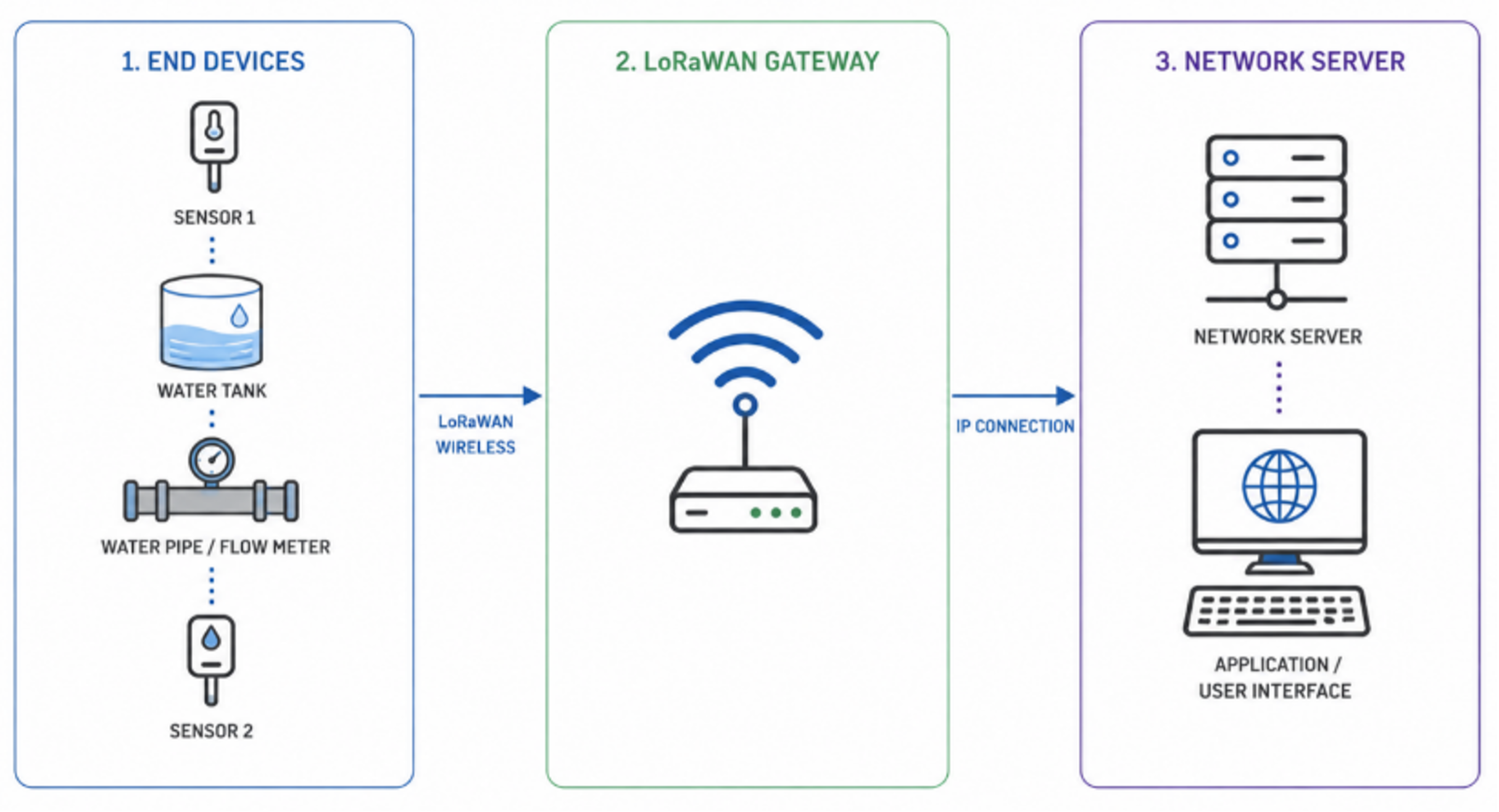
Diagram 1: LoRaWAN gateway connecting to end devices and the network server

Uses of LoRaWAN

LoRaWAN can be installed to monitor a range of parameters on farm such as water use. In this case, sensors detect water levels and flows in reservoirs, streams, pipes and troughs.

Functioning similarly to Wi-Fi, with a range of 2-10 miles, LoRaWAN systems send data to a mobile phone or computer. This data is then accessed through the Internet of Things which includes technologies such as sensors, micro-controllers, network communication protocols and Cloud platforms(5).

With sensors capable of measuring a range of environmental outputs, LoRaWAN sends early warning alerts to farmers enabling them to quickly locate and fix problems in their farming systems. These include:

  • Leak Detection - Flow sensors can identify unusual water consumption patterns, helping locate hidden leaks before significant losses occur.
  • Trough Monitoring - Alerts when water levels fall below thresholds, reducing the risk of livestock being left without water.
  • Reservoir Management - Monitoring stored water allows better planning during dry periods.
  • Pump Performance Monitoring - Pressure and flow sensors can identify failing pumps before complete breakdown occurs.
  • Grazing Systems - Remote water points can be monitored without travelling across the farm.

Whilst water management is a key component of any farm, LoRaWAN sensors can be used to monitor and measure a huge range of environmental factors. Rather than just water quantity being tracked, water quality can be measured too. Measuring temperature, pH, turbidity, electrical conductivity and dissolved oxygen answers the question of water being suitable quality for livestock health and productivity.

Other factors that can be measured and incorporated into precision agriculture include soil temperature and moisture levels, humidity and nutrient balances.

Limitations and Challenges

LoRaWAN doesn’t require the extensive set up costs associated with other communication technologies such as wired cabling, however, there are still upfront costs which can reach £1000. Robust outdoor gateways, end devices and sensors and infrastructure accessories such as mounting brackets and cables add to the cost.

Other things to consider include maintenance of the system. Sensors will need checking and calibrating, batteries changing (although battery life can exceed 10 years), and hardware and software bought and downloaded.

As with all new technology and equipment, training will be required to understand how to use LoRaWAN and how to get the most out of it.  

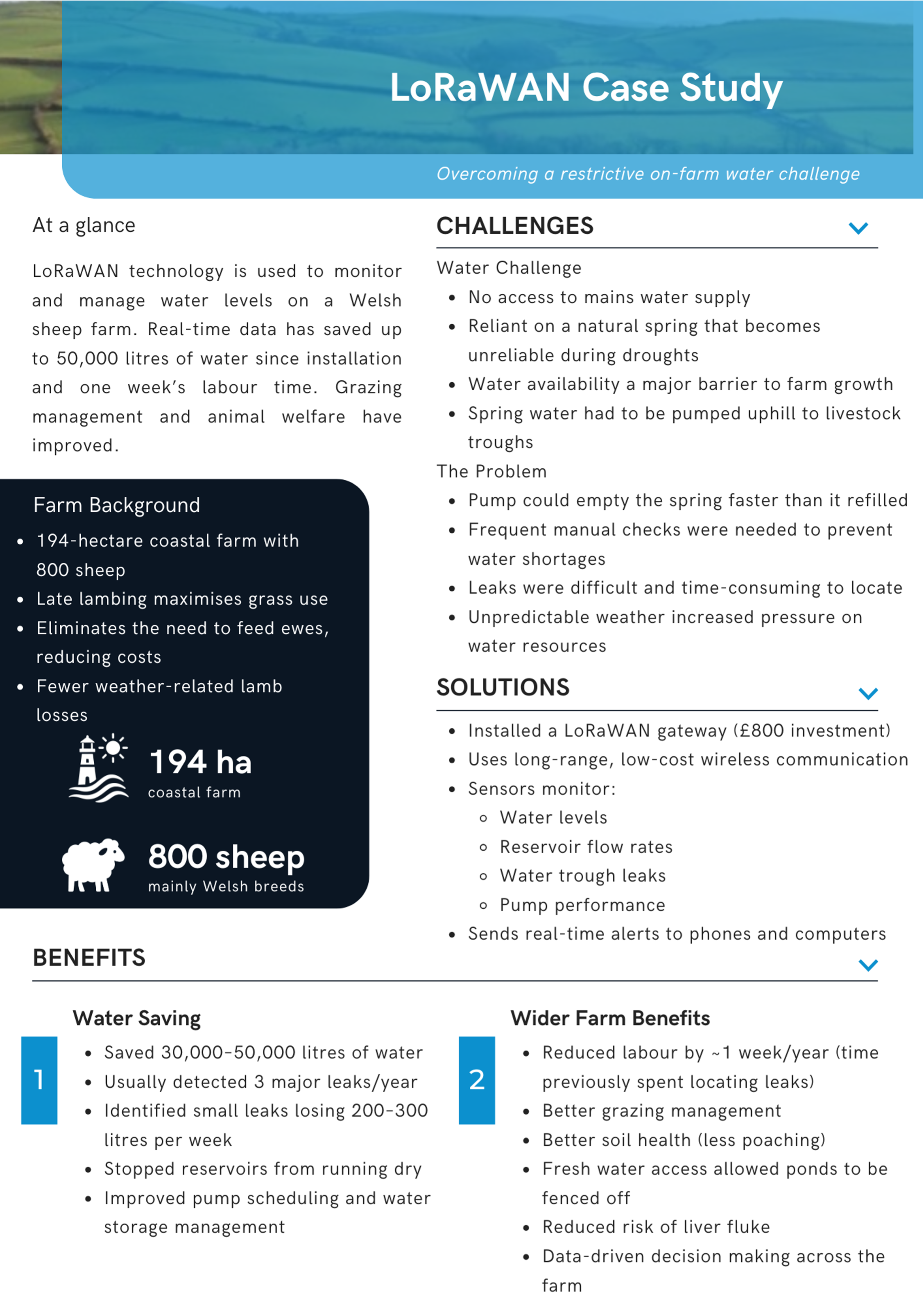
LoRaWAN Case Study: Overcoming a restrictive on-farm water challenge
Future Developments

As climate variability increases, technologies such as LoRaWAN are likely to move from being optional management tools to becoming integral components of resilient livestock farming systems.

Future advancements in LoRaWAN technology could include integration with AI-driven predictive analytics. Systems exist whereby micro-climate sensors send real-time data to farmers detailing soil moisture and nutrients and early pest detection(6). These actionable insights increase yields and reduce water and fertiliser usage. Incorporating micro-climate data from LoRaWAN sensors into AI-powered precision agriculture platform could help optimise the farming environment.

References

  1. NRW (2025). SoNaRR 2025: Water. Found at: https://naturalresources.wales/evidence-and-data/research-and-reports/state-of-natural-resources-report-2025/water/?lang=en Accessed on 16.06.2026
  2. AHDB (n.d.). Water supply problems? A guide for livestock farms. Found at: https://ahdb.org.uk/water-supply-problems-a-guide-for-livestock-farms Accessed on 08.06.2026
  3. National Infrastructure Commission Wales (2025). Climate Communication. Found at: https://nationalinfrastructurecommission.wales/climatecomms/ Accessed on 08.06.2026
  4. Almufareh, M.F., Humayun, M., Ahmad, Z. and Khan, A., 2024. An intelligent LoRaWAN-based IoT device for monitoring and control solutions in smart farming through anomaly detection integrated with unsupervised machine learning. IEEe Access12, pp.119072-119086.
  5. Codeluppi, G., Cilfone, A., Davoli, L. and Ferrari, G., 2020. LoRaFarM: A LoRaWAN-based smart farming modular IoT architecture. Sensors20(7), p.2028.
  6. FAO (2025). Science, Technology and Innovation (STI) Portal – Fasal. Found at: https://sti-portal.fao.org/innovations/fasal Accessed on 23.06.2026