
Robotic options for deterring birds
Key Insights
- Autonomous robotic bird deterrents reduce labour requirements and improve effectiveness through randomised movement, adaptive behaviour, and multisensory scaring methods.
- AI-powered vision, acoustic, and radar systems can accurately detect and identify pest bird species, enabling targeted and environmentally sensitive deterrence.
- Advanced systems such as Robotfalcon, adaptive laser technologies, and Aberystwyth University’s “Bwgan” robot demonstrate strong potential but still face challenges including habituation, weather limitations, and long-term reliability.
- Machine learning approaches that continuously adapt deterrent patterns may offer the best future solution for sustainable, effective bird management in agriculture.
The Problem
The first emergence of agriculture, specifically developments in arable agriculture, was very closely followed by the issue of bird depredation, as evidenced by human-shaped straw dolls dating back to ancient Egypt found on the fertile banks of the river Nile. Certainly not a new problem, but a complex one that has spanned thousands of years. Birds can have significant impacts throughout the crop cycle, but the damage period and susceptible stages vary according to bird species and crop. Meaning that different bird species can affect a crop at different stages of the growth cycle. Indirectly, birds can also pose food safety risks, transmit diseases and damage farm infrastructure. Depredation is also highly localised, with some farms experiencing severe losses due to large swarms of birds and others very little, with variation year on year. Critically, birds have the cognitive ability to adapt and therefore habituate to their environment, usually over days but sometimes within hours of the introduction of a scaring stimulus, rendering it ineffective. In this regard, autonomous robots excel, able to move around the field completely at random, with no need for human input, scaring using a wide variety of deterrents.
Bird Detection
The first challenge in automated systems is accurate and reliable bird detection. Key detection methods include radar tracking, acoustic monitoring and vision-based recognition. A vision-based system using AI was developed to scare birds away from airports and reduce the risk of bird strikes. The system was trained using a wide variety of photographs and achieved a mean average accuracy of 72% (up to 100%) and consistently outperformed conventional motion detection systems, particularly under challenging weather conditions such as fog or low light. Specialised deep learning models are even able to differentiate between bird species with up to 93% accuracy. This allows identification and deterrence of disruptive or predatory birds and excludes those which pose no threat or are beneficial to the crop. These systems could serve to protect ecosystems as well as arable crops. When training a visual system, it is essential to include a wide range of bird species, flight patterns and representative behaviours and movements to achieve maximum accuracy and reliability. Systems must also be trained to exclude other flying objects such as insects, bats, helicopters, drones or planes.
Acoustic detection uses a relay of microphones, smart sensor networks and AI to identify pest bird calls by comparing the frequency of incoming audio to a library of target bird noises. This identification system is often coupled with bioacoustic deterrents, i.e. either the call of a predator or a species-specific distress cry, both of which trigger a threat response. Systems can be fully automated and modulate the volume as well as move the audio between speakers to give the illusion that the predator is moving. These systems are most commonly seen in airports to reduce the risk of bird strike.
Radar-based identification systems are also commonly deployed at airports as well as wind farms. Radar is a well-established technology that is highly accurate in identifying the presence, location, speed and size of birds, but is poor at species identification. Coupled with AI and deep learning, it is still an effective tool for detecting the presence of birds.
Bird-scaring robots
There are several key features of any robotic bird-scaring device that elevate it beyond traditional methods:
- It is fully autonomous, and there is no labour requirement. Detection is fully automated, and the deterrent is activated accordingly. Robots will also navigate back to their charging hub at night.
- It is completely randomised (movement, audio, etc.), which significantly reduces habituation.
- They can utilise a variety of deterrents – robots can be equipped with a massive variety of audio, from bioacoustics (predator calls or distress cries), gunshots, human voices, etc., as well as physical deterrents such as kites, lasers and gas guns. This increases their efficacy and reduces habituation.
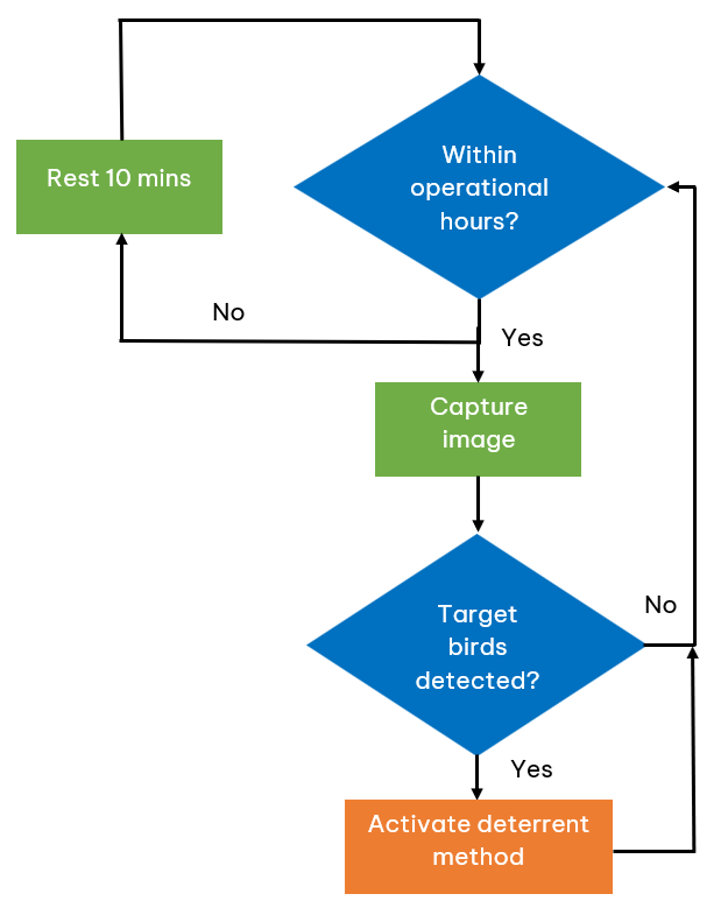
Many automated systems use flowchart-based (or conditional decision logic), where sensor inputs determine whether the deterrent is activated or not. This is simplified in the diagram below however, where machine learning is involved, this process needs to become more complex to support learning.
A good example of the use of robotics in bird scaring is Robotfalcon, although it is not automated. Developed in the context of bird strikes, the robot mimics a peregrine falcon in size and appearance, with a head-mounted camera for navigation. Compared to a standard drone, Robotfalcon clears fields of pest birds more quickly, and the fields remain clear for longer. Over the 35-day testing period, no habituation was observed; however, this may not remain true in the long term. The robot is restricted by the need for a professional pilot, battery life (15 minutes per battery) and cannot fly in rain or strong winds. So, whilst a novel solution, the Robotfalcon would likely not be useful in practice.
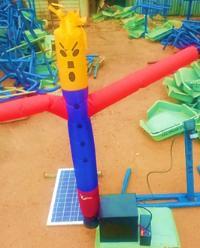
One unconventional, automated system developed in India uses a solar-powered inflatable scarecrow triggered by motion sensors. The waving motion of the inflatable tube (originally used in advertising) is erratic, making it effective in scaring birds. In testing, it is likely that the noise of the fan would also contribute. The device remains untested in the field but presents a feasible, relatively low-cost concept and highlights the use of autonomous systems and renewable energy whilst foregoing noise-based scaring, addressing concerns surrounding noise pollution.
The key issue with any bird-scaring device is habituation. Over time, birds will habituate to most methods of scaring, be it audio or movement; even lasers must be randomised to prevent adaptation. This is where the role of deep learning becomes particularly valuable. An approach termed Anti-adaptive Harmful Birds Repelling (AHBR) utilises a type of machine learning that operates by trial and error – mimicking human learning rather than relying on datasets or explicit programming. The machine plays one of a bank of sounds (explosions, predator calls and loud noises), learns the bird’s reaction, then organises sounds in patterns that are difficult to adapt to. Using vision or audio-based detection to identify bird species, this can allow for highly targeted and species-specific deterrence. In small trials, the AHBR model outperformed all other audio patterns and prevented captive birds from pecking fruit the longest (up to 46% longer). This study highlights the role that new technologies, such as deep machine learning, can play in developing smart and effective solutions to agricultural problems.
Research in the Computer Science department’s intelligent robotics group at Aberystwyth University by Dr Fred Labrosse and his team builds on the use of autonomous robotic bird scarers in arable fields. Dr Howarth’s team at IBERS is well known for its research and development of cereal crop varieties, in particular oats. However, when sowing and harvesting experimental plots, just like any arable farmer, difficulties were encountered with predatory birds consuming the crop, which can hamper experiments. To this end, Dr Labrosse and his team designed Bwgan, the autonomous robotic bird scarer. This small robot is programmed with several routes within a field boundary and navigates completely at random using vision, satellite and internal motion tracking sensors. The robot is equipped with a speaker and a wide range of different sounds that can be switched at random, reducing the risk of habituation. It is anticipated that Bwgan will work a full day without human intervention and automatically return to its solar charging station at night. The robot is currently in the early testing phase and will be subject to rigorous field trials before deployment.
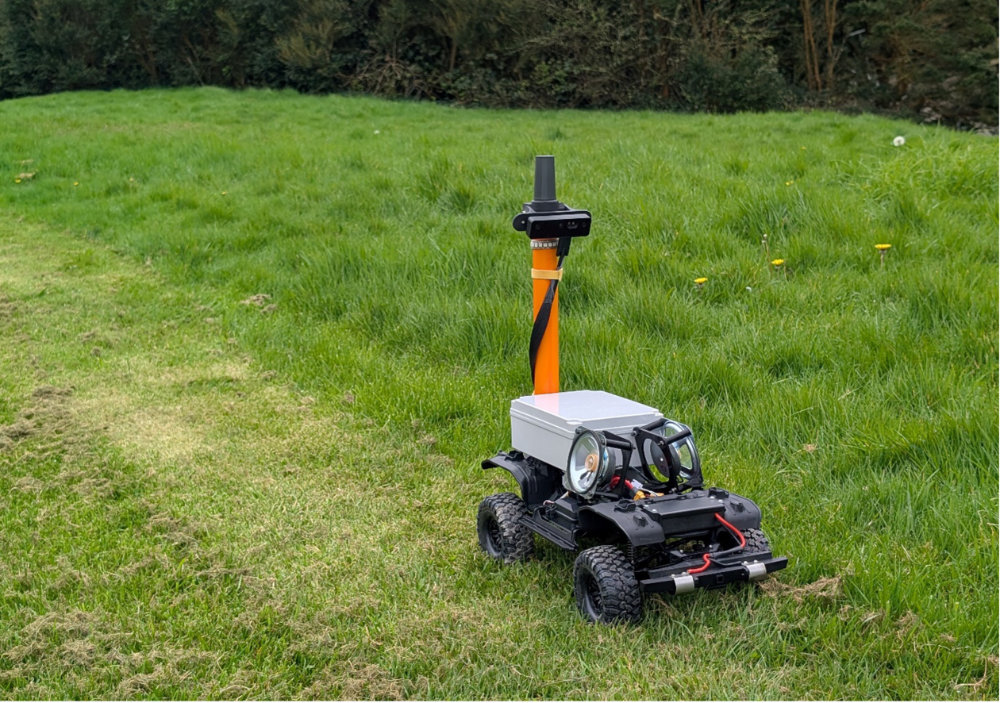
Whilst many of the more complex and advanced models that are fully autonomous and use AI and deep learning are still at a trial level, there are several commercially available bird-scaring robots. Models can be equipped with a variety of deterrents, including gas guns, microphones for bioacoustics and ultrasonic noises as well as green lasers. These robots are autonomous but require pre-programming to navigate around the field; as such, they do not learn or adapt to birds’ responses.
Lasers
Green lasers are a highly effective tool in deterring predatory birds from crops; they are silent, humane and can protect large areas (up to 12 km). Just like any deterrent, if a laser is stationary or operates in a fixed pattern, birds will quickly habituate; this is where smart systems excel. The two main approaches are:
- Autonomous systems capable of completely randomising laser movements.
- Vision-based detection systems that identify birds and only activate in their presence, many of which will specifically target the identified subject(s) for greater accuracy.
These systems reduce habituation because the laser appears unpredictable and is neither repetitive nor continually active. Particularly when the laser targets the bird or flock of birds, the threat appears responsive. Some systems may also be tailored to particularly vulnerable moments, such as landing, feeding, or roosting, to maximise efficacy.
An example of the first system was trialled in 2021 in the United States, using a battery-powered, automated green laser (532 nm) scarecrow in ripening sweet corn. The laser was programmed to move entirely at random and fully autonomously. Over 3 years, the automated laser reduced the number of corn ears damaged by 33% compared with the plot without a bird deterrent. Over this period, no habituation was observed; however, this may not be true long-term, and further studies would be necessary. Whilst the use of a laser in bird scaring is nothing new, fully autonomous systems provide novelty – the laser is pre-programmed and powers on and off by itself. Such a system would be particularly valuable in semi-urban areas or where noise disturbance is a concern.
A trial using the second system developed a fully autonomous wild bird repellent system based on deep-learning-based detection, coupled with a green laser (505–530 nm) in an outdoor duck farm in Taiwan. Detection was vision-based and trained through deep learning using a wide variety of wild bird images (6008 in total). The green laser was mounted on two control motors to allow precise targeting of pest birds. Compared to a pre-programmed system that did not use deep learning, the intelligent system was significantly more precise (86%), especially when identifying small birds. Even in images containing many ducks, the model had a very low rate of false positives (i.e. identifying a duck as a pest bird). Whilst the system achieved a daily repulsion rate of 40.3%, habituation was observed, and the laser's efficacy was significantly reduced under bright conditions. This suggests that automatic detection of birds and activation of lasers alone is insufficient to reduce habituation.
Summary
Robotic and AI-driven bird deterrent systems represent a significant advancement over traditional crop protection methods. By combining autonomous movement, intelligent detection systems, and adaptive deterrent strategies, these technologies offer a more dynamic and effective approach to reducing bird depredation in agriculture. The integration of vision-based AI, acoustic monitoring, radar detection, and multisensory scaring methods has demonstrated considerable potential in reducing habituation, which remains the primary limitation of conventional bird-scaring techniques.
Examples such as Robotfalcon, autonomous laser systems, and Aberystwyth University’s “Bwgan” robot highlight how robotics can provide flexible, low-labour solutions, that operate with minimal human intervention. In particular, the use of machine learning to modify deterrent patterns suggests that future systems may become increasingly intelligent and species-specific, improving both effectiveness and sensitivity. However, despite encouraging trial results, many advanced systems are still in early development and require further long-term field testing. Habituation remains a challenge, especially among highly intelligent bird species, and factors such as weather resilience, battery life, and operational costs must still be addressed before widespread adoption is feasible.