

Mewn erthygl yn The Conversation, mae Lewis Norton o'n Hadran Gwleidyddiaeth Ryngwladol yn egluro sut mae'r Ceidwadwyr Cymreig wedi osgoi disgwyliadau gwaethaf pobl, ond mae cwestiynau hirdymor ynghylch ei sefyllfa ddatganoli yn parhau.
The 2026 Senedd (Welsh parliament) election has transformed Welsh politics. Much of the attention has focused on the rise of Plaid Cymru and Reform UK, and on Welsh Labour’s dramatic losses. But another political story has unfolded more quietly in the background.
The Welsh Conservatives achieved 10.7% of the vote, giving them seven seats in the expanded 96-member Senedd. In the 2021 Senedd election, the party won 16 seats out of a possible 60.
On paper, that is a poor result for a party that once aspired to lead the Welsh government. But given the political circumstances facing the Conservatives in Wales, there are reasons why the party may regard the outcome as better than many had feared – and why their attention may now turn to where they stand on Welsh devolution.
To understand this, it is important to view Conservative politics in Wales through a different lens from the rest of the UK. At Westminster level, the Conservatives have historically been one of the UK’s most successful electoral machines. In Wales, however, the party has long struggled to build broad national support.
The Conservatives have not won a general election in Wales since 1859. That was before most working-class men even had the right to vote. It has also never been the largest party in a Welsh election since devolution began in 1999.
The Conservatives have usually done best among voters who identify as British rather than Welsh. The party has also struggled to persuade many supporters to vote in Senedd elections.
Despite these long-term difficulties, the Welsh Conservatives have maintained a significant presence in Welsh politics for much of the devolution era. Since 2011, they have usually served as the largest opposition party in the Senedd. The 2021 election handed them their strongest result to date.
Those historical factors made the mood before this election particularly bleak for the party. After the Conservatives’ heavy defeats across Britain in recent years, many commentators expected the Welsh branch to suffer a heavy defeat of its own.
One poll projected the party to achieve a vote share of 7%, winning just one seat. That would have left leader Darren Millar as the Conservatives’ lone representative.
Reform UK’s rise intensified those fears. Reform appeals to many of the same voters as the Conservatives, particularly older, socially conservative and strongly unionist voters. Its rise to become the Senedd’s official opposition appears to have come largely at the Conservatives’ expense. Before the election, the party suffered numerous defections at both public-facing and backroom levels.
Reform performed especially strongly in areas that had traditionally been among the Conservatives’ better-performing parts of Wales, including north-east Wales, Monmouthshire and Newport.
Against that backdrop, seven seats was not the catastrophe many predicted. It is far from where the party wants to be, but it avoided the near-erasure that some had predicted.
Next steps
With the election over, and enough members returned to form an official Senedd group, the Conservatives now face a different question: what comes next?
There is, realistically, no immediate route into government. Reform, the Conservatives’ only realistic coalition partner, did not win enough seats to make such an arrangement viable.
Instead, it will need to settle for spending the coming years as a smaller opposition force, struggling to shape the direction of either a Plaid Cymru minority administration or a broader coalition government.
But there are historical parallels that may offer Conservatives some encouragement. Following the 1997 UK general election, the Conservatives were wiped out entirely in Wales at Westminster. The creation of the then National Assembly for Wales two years later, using a more proportional voting system, gave the party a political foothold from which it slowly rebuilt.
Under the leadership of Nick Bourne, the Welsh Conservatives spent much of the following decade trying to present themselves as a distinctly Welsh conservative party that accepted devolution rather than resisted it.
In some respects, the party finds itself in a similar position today. Since the 2024 general election, the Conservatives have again had no Welsh MPs at Westminster, while retaining only a relatively small but workable group in the Senedd.
Once again, the party faces difficult questions about its identity, purpose and relationship with Welsh devolution. This time, however, it must answer them while competing with a larger and more electorally threatening party to its right.
That debate over devolution is unlikely to disappear any time soon. Before the election, the party had already been wrestling internally with arguments over whether it should continue supporting the Senedd in its current form.
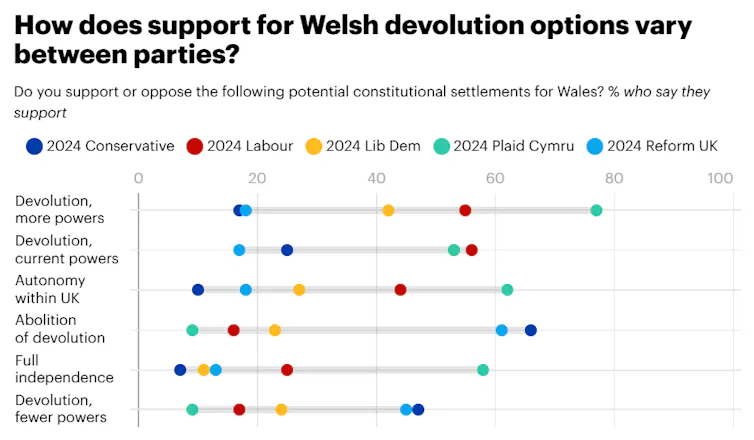
Leader Darren Millar insisted that abolishing the Senedd was off the table. But many Conservative voters in Wales still want the institution abolished or its powers reduced. After such a disappointing election result, some within the party may conclude that adopting a more anti-devolution position is necessary if the Conservatives are to recover electoral support.
The danger, however, is that moving in that direction would reverse much of the “Welshification” strategy that previously helped the party establish itself as a credible force in Welsh politics.
Whichever path the Welsh Conservatives choose, the consequences are likely to shape not only the party’s future, but also the wider direction of Welsh politics in the years ahead.
Lewis Norton, PhD Candidate at Department of International Politics, Aberystwyth University
Mae'r erthygl hon wedi ei hailgyhoeddi o The Conversation dan drwydded Creative Commons. Darllenwch yr erthygl wreiddiol.


