
Rewilding Aberystwyth University
Why Rewilding University Campuses Matters
We are living in an era shaped by interconnected climate, ecological, and biodiversity crises. These challenges cannot be addressed in isolation: climate change accelerates biodiversity loss, while degraded ecosystems reduce society’s ability to adapt to environmental change.
Responding to these challenges is not solely the responsibility of large conservation organisations or major landowners. Universities, local authorities, community groups, and individuals all have an important role to play in supporting nature recovery and strengthening ecological resilience across both urban and rural landscapes.
Universities are particularly well placed to contribute; not only through research and teaching, but also through practical action across their campuses. Historically, institutional and urban landscapes have been designed primarily around human needs. Yet campuses, like cities, are also habitats for plants, animals, fungi, pollinators, and many other forms of life. Increasingly, universities are recognising the importance of creating spaces that support both biodiversity and human well-being.
Rewilding Aberystwyth University
Aberystwyth University is transforming parts of its campus into biodiverse habitats through native hedgerows, wildflower meadows, and tree planting to support wildlife, ecological connectivity, and multispecies well-being.
At Aberystwyth University, biodiversity initiatives aim not only to improve access to nature for people, but also to support wildlife for its own intrinsic value. Creating space for nature recognises that healthier ecosystems are essential to long-term environmental sustainability and that humans share these environments with many other species.
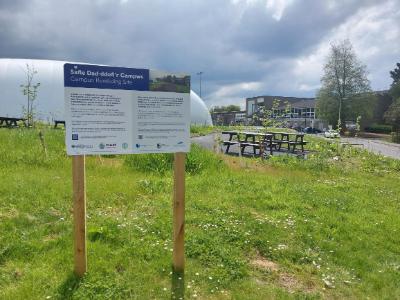
One rewilded area on campus demonstrates this approach in practice. Designed to support local wildlife while remaining accessible to staff, students, and visitors, the site forms part of a key walking route across the University estate. Native hedgerows, broadleaf trees, and wildflower meadows provide food, shelter, and nesting habitats for birds, mammals, bees, butterflies, and other important pollinators.
More than 50 volunteers helped plant and establish the site, with funding support from the Ceredigion Nature Partnership. Plants were also supplied in collaboration with the National Botanic Garden of Wales through its Rare Welsh Flora project, contributing to the conservation of botanically distinct Welsh flora alongside wider habitat restoration efforts.
Multispecies Justice and the MUST Project
The initiative forms part of the MUST (Enabling Multispecies Transitions) Project, which explores how universities can support biodiversity, climate action, and more sustainable futures.
The project is supported by researchers from Aberystwyth Business School, including PhD researcher Saman Sobhani and Professor Mike Christie, whose work focuses on biodiversity, ecosystem values, and multispecies justice.
Towards Shared Multispecies Futures
As climate and biodiversity pressures intensify, projects such as the Aberystwyth University Campus Rewilding Site demonstrate how universities and other institutions can contribute directly to ecological restoration while creating healthier and more connected environments for both people and wildlife.
Through habitat creation, conservation partnerships, volunteer involvement, and research-informed campus management, Aberystwyth University is contributing to a growing movement that reimagines campuses as shared environments where biodiversity recovery, climate action, education, and community well-being can be advanced together.