
Waste & Recycling

Recycling: let's Get It Sorted

Collection Days

Fferm Penglais :

Waste Stream

Collection Day

Food

Friday

Glass

Tuesday

Paper / Cardboard

Tuesday / Friday

Plastic / Metal / Cartons

Tuesday / Friday

General Waste 

Tuesday / Friday


All other Residences:

Waste Stream

Collection Day

Food

Thursday

Glass

Thursday (fortnightly)

Paper / Cardboard

Wednesday

Plastic / Metal / Cartons

Friday

General Waste

Monday


Wales is the world’s second best recycling nation. By working together, we can get to No 1!

In April 2024 the Welsh Government introduced the Recycling Legislation. The law requires all workplaces, including businesses, public bodies and the third sector, to separate recyclable materials from their general waste.

Your efforts in correctly sorting your waste will contribute to the University’s sustainability goals and help enhance the quality of recyclable materials.

There is a recycling area in each kitchen with the following guide……….
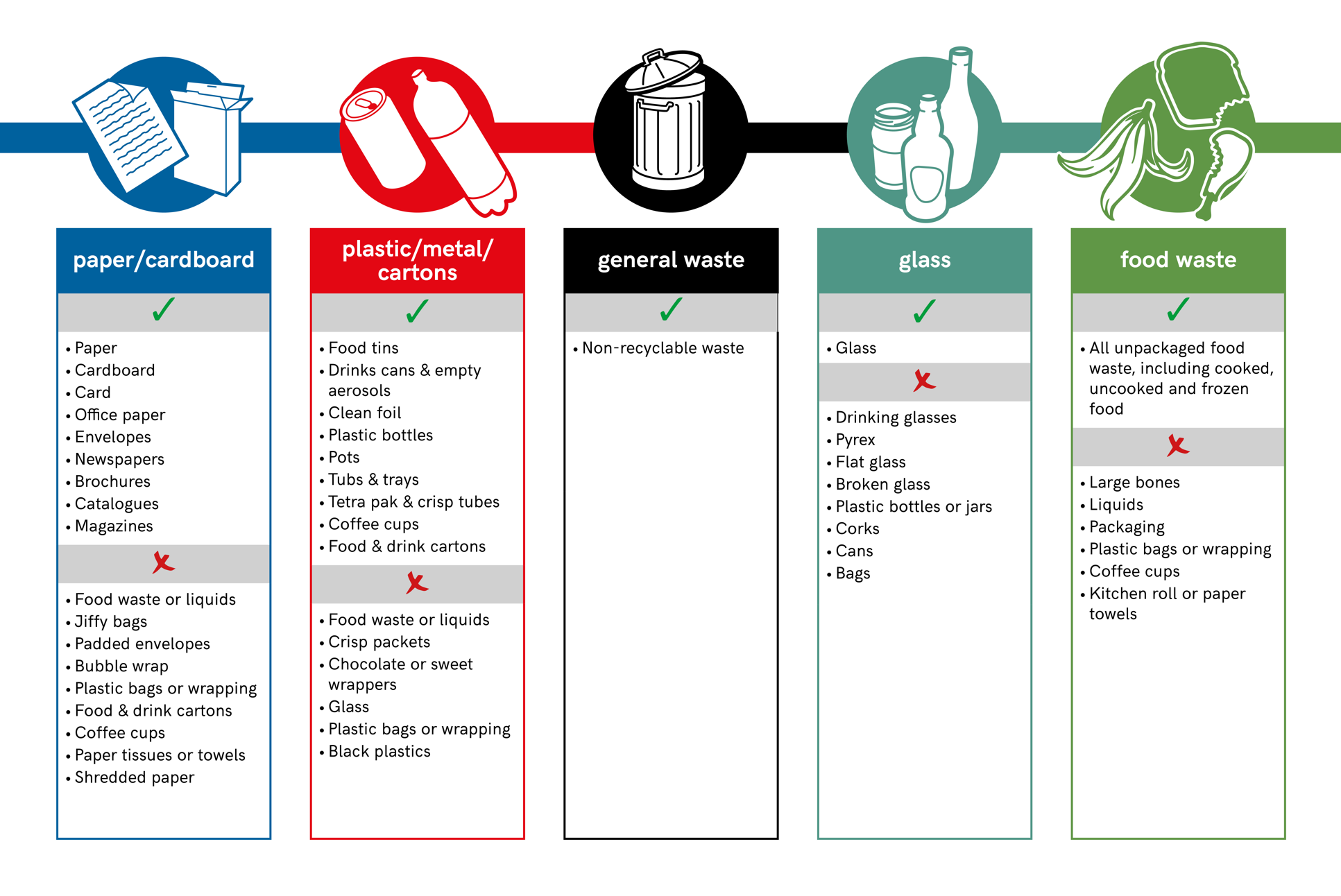
  • Follow the guide and make sure you use the correct bin.
  • All recyclable items must be clean and dry.
  • Work together, share the housework, and empty your bins regularly.
  • Make sure you use the equivalent bin in your external bin store.
  • Recycling bags and food waste bags can be collected from the Accommodation Office at Y Sgubor, Fferm Penglais. You will need to buy your own general waste black bags.
  • Please do not use the recycling bags for general waste.
  • Please do not use Black Bags for recyclable waste


Collection Days

Fferm Penglais :

Waste Stream

Collection Day

Food

Friday

Glass

Tuesday

Paper / Cardboard

Tuesday / Friday

Plastic / Metal / Cartons

Tuesday / Friday

General Waste 

Tuesday / Friday


All other Residences:

Waste Stream

Collection Day

Food

Thursday

Glass

Thursday (fortnightly)

Paper / Cardboard

Wednesday

Plastic / Metal / Cartons

Friday

General Waste

Monday

What other recycling bins are available across the University?

  • A bin for used vapes is available on the main piazza, just outside the Student Union building
  • Battery Bins are around the campus buildings
  • Used Clothes banks are available in:
      • PJM (Just beside the Amenity block)
      • Cwrt Mawr (opposite block L)
      • beside Cledwyn Building 

End of Term Donations

Across our Residences, Donation Stations will be set up to collect reusable items. These stations are a great way to reduce waste and support the community.

Some items are picked up by students, while others are donated to fantastic local organisations, including:

How do dispose of IT, Electrical and Electronic items?

Waste IT, electrical and electronic items are referred to as WEEE waste.

WEEE stands for “waste electrical and electronic equipment,” as a general rule it is anything that gets plugged in, is wired into an electrical source or has a battery.


Can I put any WEEE waste into the general waste bins?

You are now legally required not to put WEEE waste into the general waste stream, the black bins around Campus.

The Waste Separation Requirements (Wales) (Amendment) Regulations 2026 require workplaces to present small waste electrical and electronic equipment separately for collection and onward recycling from April 2026. This regulation is part of a broader set of mandatory workplace recycling laws in Wales, which have been designed to ensure that waste is managed in a manner that promotes high quality recycling.


How do I dispose of WEEE waste?

For small items such as keyboards, computer mice or calculators – drop them off at the Hugh Owen Library where they will be assessed for reuse or recycling.

For larger items such as computer screens or base stations, fridges or for larger quantities of items, contact Facilities to come and collect them. These items are also assessed for reuse or recycling.

  • While you are waiting on Facilities collecting these items, you must keep them in a locked area to ensure they are complaint with data protection processes.
  • Make sure that no components are removed from the University equipment before it is collected. Technicians who repurpose equipment as part of their role will breakdown the kit for reuse as appropriate.


If you have assets worth in excess of £10 000, you must complete a “Useful Forms” and return this to the finance department before disposal.


What Happens to WEEE waste?

WEEE waste is initially collected and assessed for reuse.

When staff IT equipment is collected, ITS ensures it is handled securely and responsibly. All items are first brought to a restricted‑access, CCTV‑monitored area where authorised IT staff assess them for reuse, repairs, or spare parts. Working devices are redeployed within the University wherever possible, useful components are removed to help upgrade or keep other systems running. Any equipment that still has resale or refurbishment value may be passed to approved recycling partners. Items that cannot be reused internally are transferred to our accredited WEEE disposal contractor, who provides secure DIAL‑rated transport for data‑bearing devices. They carry out certified data wiping or physical destruction as required, before refurbishing suitable items or recovering materials through specialist recycling channels. This process ensures that data protection, environmental responsibilities and Duty of Care requirements are fully met, while reducing waste, supporting sustainability and ensuring the University gains maximum value from its IT assets

Other items such as fridges, microwaves, kettles and toasters from halls of residence are collected by LAS Recycling and taken to their waste transfer station to maximise the amount of material recycled.


Did you know?

  • Recycling one aluminium can will save enough energy to power a television for up to 3 hours!
  • The average household in Wales throws away £49 worth of food on average every month!
  • One tube of recycled toilet paper saves enough energy to charge your smartphone twice!
  • It takes 24 trees to make a tonne of paper!
  • 1 tonne of recycled paper saves 7,000 gallons of water!
  • There are 4 billion trees that are cut down for paper every year!